Tuesday, February 24, 2009

Lyon 1 Barca 1

1. Barcelona started their run to the 2006 Champions League title by conceding first on the road at Chelsea from a left wing set piece before they equalized from a header. Manchester United started their run to the 2008 Champions League by going behind 1-0 at Lyon and then fighting back for a 1-1 draw. If you believe in omens, this was a good start.

2. Barca's two biggest goals this season - the winner against Real Madrid and the equalizer against Lyon - were both corners from Xavi that were headed into the goal mouth by defenders and then knocked home by forwards. If you want a major difference between this Barca side and the versions of the last two years, it is the attention to detail on set pieces.

2a. Another difference with this team: they're in great shape. Pep only made one sub all game because the players showed no signs of fatigue. I'll be interested to see the line-up this weekend for a big match at Atletico.

3. I'll quote myself from last night:

Victor Valdes had an absolute howler to gift the Pericos their second goal. If he loses confidence as a result, then he could single-handedly give Lyon a result.


Is Victor Valdes Catalan for David Seaman? It's not so much that he surrendered a direct free kick goal from a horrible angle on the left wing as it is the fact that he was nowhere close to the ball. His feet were never underneath him, so he couldn't even jump for the ball. Valdes then made a hash of one or two additional chances. He officially has a crisis of confidence. In his defense, he did a great job cutting out a hard cross later in the first half that would have been a guaranteed second goal for Lyon. Valdes was better as the match went on, although nowhere close to the standard set by Lloris at the other end.

4. Barca were a little unlucky in two instances. First, Samuel Eto'o's shot crashed off the post with Thierry Henry sitting right there for the tap-in, only the ball caromed off in the wrong direction. Second, Fabio Grosso's deflection of a Dani Alves free kick was palmed out by Lloris, but if he deflects the ball anywhere towards the yawning net, then Barca equalizes earlier.

5. Barca's man of the match was Xavi. He was outstanding in the middle of the park from start to finish. He's the fulcrum around which Barca can dominate possession and get various players involved. Although I'm not his biggest fan, Rafa Marquez was fairly good after a nervy start. Then again, the same can be said for the entire Barca defense, who collectively appeared to be surprised that Lyon were daring to attack them and were correspondingly vulnerable for the first 20-30 minutes. Assuming there is no upset in the second leg, Lyon lost the tie by not going two up when they had Barca on their heels.

6. Benzema and Messi both had one instance in which they put their head down and dribbled while missing open teammates to their right sides. Those of you who thought that Boumsong could handle Messi in open spaces, raise your hands. That's what I thought.

7. Kudos to Lyon's support, who made for an outstanding atmosphere. I thoroughly enjoyed the game, other than the slow death that is watching one's favored team trail for an hour.

8. Lyon employed the defensive strategy that succeeded against Barca last year: clogging the middle and daring Barca to attack wide. It worked just fine aside from Barca's new-found ability to score from corners. Barca did attack at speed on a couple occasions, which is also something they struggled to do last year. I'll be interested to see how Guardiola approaches Lyon in the second leg, as well as other opponents who use this old strategy.

9. EPL sides allowed three goals in 14 knock-out matches against non-EPL sides last season in the Champions League. They're two matches in this year and have barely allowed a quality chance. Maybe the talk of the English sides other than United looking suspect is inaccurate. Maybe the EPL is good enough to make good teams look average. I hate admitting it because of my preference for La Liga, but I'm also a numbers guy and these numbers are impressive.

10. Jose Mourinho, you had weeks to set your team for United and you came up with Nelson Rivas? Really?

Because Posting Video of the Wehrmacht Marching under the Arc du Triomphe would be Uncomfortable...

Mel Gibson's oeuvre ought to come in handy in later rounds.


This will be a little awkward if Henry hits the winner.

Was Raul Mondesi not Available?

Say hello to the Braves' new left fielder: Garret Anderson. Garret enjoys candle-lit dinners, long walks on the beach, and never taking a walk. Now, instead of having one outfielder who swings at everything, the Braves have two. Moreover, because Anderson is a wily veteran, he will almost certainly find his way into Bobby Cox's heart and will be impossible to remove from the lineup, regardless of whether he represents an upgrade over Brandon Jones. Anderson has been marginally below league average in terms of OPS in three of the past four seasons, all while playing a power position. Sure, you don't exactly expect huge numbers for $2M per season, but what are the Braves going to get for that money that they couldn't have gotten from the pupu platter of minor leaguers competing for at-bats in the outfield? I suppose that Anderson putting up a .775 OPS in 450 at-bats against right-handed pitchers wouldn't be the end of the world. If you buy into chemistry as being important, he'd probably be a good guy to have around a bunch of young players.

Joe Sheehan at the Baseball Prospectus made an excellent point regarding the Braves' failure to acquire a good left fielder: the team's smart purchases in free agency (which have to be attributed in large part to the lucky breaks that A.J. Burnett and Rafael Furcal elected to spurn the chance to play in Atlanta) have put it on the precipice of being a playoff team, so additional spending on a left fielder could have paid for itself by getting the team back into the playoffs. Here is the two-sentence thesis:

I don't mean to peg the Braves as penurious overall, just to point out that they stopped spending money at exactly the point where they might have gotten the most bang for their buck. Buying a left fielder like [Adam] Dunn would have helped make the significant investments in the rotation — more than a third of the payroll is tied up in the three new starters — pay off.


Sheehan suggests that the team would benefit from Josh Anderson in center and Gregor Blanco in left to maximize on outfield defense. Personally, I can't imagine that outfield defense could be so valuable as to make up for the holes in the lineup that those two would represent, especially when the Braves are already getting relatively little from first base and right field.

Monday, February 23, 2009

Quick Champions League Thoughts

United-Inter - This is going to be disappointing. These two teams are stocked with talent and are each about to win their third straight domestic league title. They also have cagey coaches who will take few risks, which means that the games will be slogs in the midfield. Expect a lot of Cambiasso and Zanetti running into Carrick and Fletcher or Giggs. Do not expect a lot of Ibrahimovic and Ronaldo galloping at defenders. In the end, I like Inter because of Mourinho's record against Ferguson, the injuries to United's back line, the recent track record of defending champions losing in the round of 16, and Adriano rounding into form. 1-0 Inter at the San Siro and 1-1 at Old Trafford.

Chelsea-Juve - A few weeks ago, I was certain that Juve were going to knock the Blues out of Europe. Now, I'm having my doubts. Guus Hiddink is a proven knock-out tournament manager. Chelsea were always going to get a bounce from their new coach; that bounce will be stronger when that new coach is Hiddink. Ranieri is a nice guy and all, but he is also far more likely to make the tactical blunder that will decide the match. Juve have been stuttering in Serie A, allowing Inter to build a huge lead. The Bianconeri don't have the depth that they once did because of Calciopoli and this is the time of year that their thin bench will show. 2-0 Chelsea at the Bridge and 1-1 in Turin.

Arsenal-Roma - Hell if I know. Arsenal fans are getting what their team (does not) pay for. The squad is thin and young, as it's been for the past four years. They do have enough quality to win a tie like this, but Roma are the hotter team and they have the second leg on the banks of the Tiber. Give me the Giallorossi to score one for Serie A. 2-1 Arsenal at the Emirates and 3-1 Roma at the Olimpico. This will be the best of the four ties involving English teams because Arsenal and Roma have styles that will play well together. Speaking of which, I'm not often inclined to agree with Arsene Wenger, but he's spot on when he complains about Premiership sides doing precious little to attack. This has not been an especially attractive season in England. Honestly, can you pick out one team that has produced exciting games, week in and week out? Paging Senor Valdano...

Liverpool-Real - For me, this is like Notre Dame and Ohio State playing. On one side is the detestable arch-rival; on the other side is my least favorite team in the sport. At least I can root for my conference by cheering for Los Merengues. So, uh, hala Madrid?!? In the end, it won't matter because the 'Pool are going to win this tie. Benitez is hard to beat in a knock-out competition and doubly so when he has the second leg at home. He can park the bus at the Bernabeu, grind out a result, and then rely on the Kop intimidating an opponent and the ref for the second leg. I'm angry already just thinking about it. Juande Ramos is a fine tournament manager in his own right, but he isn't quite defensive enough to beat Benitez at his own game. Honestly, would you bet on the team that has made three Champions League semifinals in the past four years or the team that has lost at this stage in each of the past four years? Plus, as is usually the case, Liverpool have only Europe to play for. 1-1 at the Bernabeu and 1-0 at Anfield.

Barca-Lyon - I'm not worried. I might have cause to be after Barca lost a home match against last-placed Espanyol over the weekend, but the team had a clear case of "look ahead!" and they were thrown off by a horrendous red card decision. Barca created almost every chance in the match. If there is an acceptable way to lose, that's it. There are two causes of concern for the Blaugrana. First, Victor Valdes had an absolute howler to gift the Pericos their second goal. If he loses confidence as a result, then he could single-handedly give Lyon a result. Second, the injury to Eric Abidal could force Puyol to play left back, which weakens Barca at both left back and in the middle. I'm OK with either Pique or Marquez; I'm not OK with both. All that said, in Messi I trust. As far as Lyon is concerned, they have been underwhelming domestically, but they've been playing defensively and that style will work against Barca. Benzema could be a tremendous counter-attacking weapon against a side that get farther forward than any other. However, Lyon always come undone at this stage and Jean-Alain Boumsong is going to be prominently involved. I have a good feeling about Toure Yaya choking the life out of Lyon. Finally, Barca have a sterling record when they have the first leg on the road in recent years. They can wait for the opponent to come attack them without pressing too hard. Lyon are faced with a Hobbesian choice: sit back and blow the home leg or get forward and risk road goals. I'll bet they do the former. 0-0 at Stade Gerland and 3-1 at the Nou Camp.

Atleti-Porto - I've changed my mind on this tie. Atleti looked dead and buried at the start of the year, shipping goals by the bushel. They have a horrendous record against quality opponents in La Liga. That said, they have talent and they should get a bounce from new coach Abel Resino. He'll organize them enough defensively that a moment of magic for Kun Aguero will get them through. This being Atleti, they'll do just enough to get their fans' hopes up before crushing them. 1-0 at the Calderon and 2-1 at Estadio do Dragao with Atleti going through on road goals.

Villarreal-Panathiniakos - There's always one surprise team in the quarterfinals. Last year, it was Fenerbahce. This year, it's the Turks friends from across the Aegean. I have a soft spot for Henk ten Cate and Villarreal are stuttering just enough to let Panathiniakos become the team that everyone wants to play in the quarterfinals. 1-1 at El Madrigal and 1-0 at the Olympic Stadium.

Bayern-Sporting - Surely Die Bayern aren't this bad. 2-2 at the Alvalade and 2-0 at Allianz Arena. Bayern then get a couple weeks to sort out their alarming drop in form before they play one of the big boys in the quarters. Maybe Der Kaiser will think next time before he opines that the team's best player can move to Real if he so chooses. Since when was Beckenbauer such a softie?

Thursday, February 19, 2009

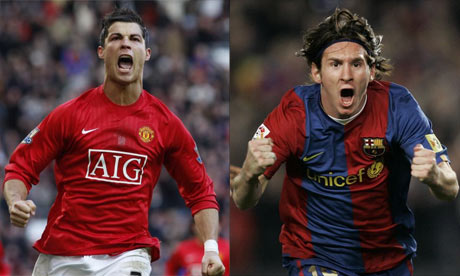
Messi vs. Ronaldo

[One programming note: with football and Signing Day over, the NBA in a bit of a lull, and baseball in the "what does Jeter think of A-Rod!?!" silly season, we're probably going to be a little footie heavy over the next several weeks. With the Champions League about to heat up, this is as good a time as any to starting picking up with soccer. To those of you who are new readers, I recognize that a detailed discussion about Barcelona's options at the defensive midfield spot isn't exactly an Atlanta sports issue. I've completely transitioned from listening to sports talk radio to the World Soccer Daily podcast on my iPod in the 40 minutes or so that I'm commuting to and from work each day, so I have soccer on the brain a lot more than anything else sports related. My apologies to the readers who don't like soccer. I promise the occasional college football, Hawks, and Braves post when a subject strikes my fancy.]

There is some debate as to the best player in the world right now between these two guys:


Here is the debate hashed out last spring when the two players met in the Champions League semifinal. Here is a 76-page thread on the subject at Big Soccer.

You won't be surprised that a Barca supporter like me would come out on the Messi side of the debate. Because we like lists, here are the reasons why:

1. Messi is better at creating goals. When arguing first, one should always start with the positive case for one's proposition. When arguing second, one should negate the opponent's best or most dangerous argument right off the bat. Because I like rebutting, I'll start with the primary argument for Ronaldo: he is bigger and can score with his head. That's a little like saying that a Jeep is better than a Ferrari for driving across the country because the Jeep can go off road. To quote Bob Dylan in "Lay Lady Lay" (the Hard Rain version), who really cares? To quote Dietrich from Raiders of the Lost Ark, only your mission for der Fuhrer matters. Does the player produce goals for his team by scoring them himself, by setting up his teammates, and by attracting defenders to create open space? The means don't matter as long as the end entails the ball in the back of the net. Right foot, left foot, head, knee, hands (if you're Argentine), they all look the same in the dark. Put another way, Maradona couldn't score with his head, but his reputation seems pretty secure.

This season, Messi has 25 goals in 23 starts for Barcelona. In his ballyhooed 2007-08, Ronaldo had 42 goals in 45 starts for Manchester United. Messi is on pace to beat Ronaldo for goals, regardless of the fact that his mop top rarely makes contact with the ball. Messi has 13 assists, which is five more than Ronaldo scored in the entirety of his 2007-08. Leo is a better passer, full stop. So, let's ask this question again: who creates more goals?

2. Messi's skills translate better against top opponents. The rap against Ronaldo that he's not a big game player should have been somewhat dispelled by his goal in the Champions League Final last May, not to mention his fine performance in the road leg against Roma in the quarterfinals. That said, Messi's skills are more useful against a great opponent. Quality defenses will close down the space afforded to attacking players. Messi's primary skill - a ridiculous ability to dribble in tight spaces with the ball attached to his boot - comes in handy in the conditions that a great player will face against a big opponent. Though a fine dribbler, Ronaldo is more noted for galloping into space with the ball. He doesn't have Messi's ability to get around in a phone booth. To Ronaldo's credit, his heading ability does come in handy against good defenses.

3. Messi is more valuable. The gnawing concern that I and most Barca fans have about the current version of the Blaugrana is that they are Messi-dependent. On a number of occasions, Barca have looked mortal without Leo and then dominant as soon as the Flea has come onto the pitch.

Exhibit A: at Shakhtar Donetsk in the Champions League, Barca trails 1-0, Messi comes on and scores twice, and Barca wins 2-1.

Exhibit B: home against Basel in the Champions League, Barca cannot break down a poor Basel side until Messi comes on and promptly scores. The game finishes 1-1.

Exhibit C: at Racing Santander in La Liga, Barca trails 1-0, Messi comes on and scores twice, and Barca wins 2-1.

Exhibit D: at Real Betis in La Liga, Barca trails 2-1, Messi comes on and Barca equalizes in a 2-2 draw.

Messi's not only playing for the best team in the world, but he is essential to their success. Barca are full of great players, but one is especially useful. The uncomfortable conclusion for me is that Barca are very vulnerable to a Messi injury. In fairness, it must be said that Ronaldo is bigger and more durable than Messi. On the other hand, Messi is far less likely to miss a game with knob rot. (HT: Gareth Keenan.)

4. Messi is younger. This one is self-explanatory. A 21-year old dominating is a little more impressive than a 23-year old dominating.

5. Ronaldo is a complete prat. Google agrees 75,800 times. Cristiano spent the summer whinging about being a slave and doing all he could to force a transfer to Real Madrid, where he will fit in perfectly. He can be a black hole with the ball. He dives at the drop of a hat and immediately looks to the ref upon contact with the ground. He poses like a fucking model before taking free kicks. If we're comparing Messi and Ronaldo, shouldn't Messi's ability to refrain from being a chemistry-killing ass matter? After the Ronaldinho flame-out, I'm quite conscious of the importance of having unassuming guys who just want to play as opposed to hedonists with too much product in their hair.

Tuesday, February 17, 2009

Taking Stock of the Hawks after the All-star Break

1. Overall, if you would have told me before the season that the Hawks would be 31-21 and firmly in the #4 spot in the East, I would have been overjoyed. The consensus before the season was that the team would be in danger of not making the playoffs, in light of the fact that they only won 37 games in 2007-08 and several non-playoff teams in the East had gotten better, namely the Sixers and the Bulls. The Hawks are on pace for 49 wins and their record is consistent with their scoring margin, so it cannot be said that the team has been especially lucky. I was a tad skeptical coming into the year because of Josh Childress's departure and the retention of Mike Woodson, but everything has worked out. The young players have developed, the bench hasn't been the disaster that we feared, and Mike Bibby is having a career year.

2. What do the Hawks do well? According to the numbers, they shoot the ball well, they don't turn it over, and they have a good assist rate. Does that sound like a team whose point guard is having an outstanding season? What do the Hawks not do well? Rebound. The Hawks are an above-average offensive team and an average defensive team, but they struggle to get rebounds on either end. Does that sound like a team playing a power forward at center? Or a team with only one quality reserve big man (Zaza)? Oh, and the Hawks are also 29th in the NBA in free throw percentage, which is very hard to explain for a team with a number of good shooters. The primary culprit has been Josh Smith, who gets to the line more than anyone else on the team (good!), but is shooting a woeful 58% (bad!), which is well below his career average.

3. And speaking of our local talent/enigma, Smith has shot the ball better this year than he has in years past, but all of his other numbers - blocks, rebound rate, assist rate - have gone down slightly. It is worth noting that Smith has the second-best plus-minus among the Hawks' regulars. Maybe we should see his performance this season as a "less is more" situation? His scoring, assists, and turnovers are down because his teammates are seeing more of the ball (and why not with Marvin Williams and Bibby having good scoring years?), so maybe Josh is a slightly more efficient player?

4. If I had to point at one reason why the Hawks are where they are, it would be Mike Bibby. Take a gander at these numbers. The Hawks rank in the top ten in the NBA at two positions; they get the sixth best production at shooting guard and the seventh best production at point guard. Bibby shoots the ball well, his assist rate is good, and he never turns it over. His performance has created an interesting dilemma for the Hawks in the off-season. Do they re-sign a player coming off of a great year (in a contract push) who is in the decline phase of his career? As with most free agent topics, the question comes down to the money and the length of the contract.

5. One thought on the rebounding issue: Zaza is a better rebounder than Horford. In light of that fact, it's not especially surprising that the Hawks' best unit (and the fifth best unit in the NBA) is the Bibby-Johnson-Evans-Smith-Pachulia lineup. There are major sample size issues with that lineup, but it would be worth Mike Woodson giving it a little more time to test it. With the back court scoring so well, it stands to reason that the Hawks putting their best defensive/rebounding front line on the court would work out.

6. This stat is, without a doubt, the most surprising one of the season for the Hawks. Not only has the bench not been the disaster that John Hollinger and others predicted before the year, but it's actually been a net positive and ranks 11th in the league in plus/minus. Interestingly, the Hawks' bench has played the second fewest minutes of any NBA bench, but they are third in points per possession. So here's the question: is Mike Woodson making a mistake by not using an asset enough or is that asset valuable because he's using it sparingly. In any event, it would be worthwhile for Woodson to dial back on the starters' minutes a little in the coming weeks, especially if the team has a solid lead for the #4 spot in the East.

7. Because I won't stop being contrary and pointing out that Billy Knight wasn't a bad GM (despite the Chris Paul mistake), note that the Hawks have three of Bill Simmons' top 40 players and none of his 25 worst contracts.

Friday, February 13, 2009

Welcome to the Dark Side, Mark Bradley

If this is what we can expect from Mark Bradley now that he has made the move to blogging, then the future just got a little brighter. Complaint about the media deifying a figure for BS reasons? Check! Use of data to support the argument? Check! Sufficient levels of snark? Check! Insult directed to Peter King? Check! All Mark is missing is a back-handed joke at King's weight and he'll truly be ready for a Darth prefix on his name.

Now, if Mark can just moderate his tendency to make excessively optimistic predictions about the local teams. We don't need the burden of a "Hawks over Celtics in the second round of the playoffs" jinx.

How about a Fourth Reason

The audience for USA-Mexico on Univision dwarfed the audience for Duke-Carolina on ESPN.

You have to appreciate the passion of Mexican futbol fans. El Tri are playing miserably right now. They're coached by Sven Goran Eriksson, who is most noted for an inability to beat Big Phil Scolari. Eriksson has one foot out the door already. Mexico's captain starts for Barcelona and was last seen getting red-carded in Santander, a feat that he repeated on Wednesday night. Despite all of their struggles, Mexicans turned on their TVs in droves to watch the match against El Tri's arch-rival. You have to admire that loyalty.

I'd be very interested to know what ESPN's upper management thinks of those numbers. Duke-UNC is supposed to be the pinnacle of the college basketball regular season, but it just drew a little more than half the audience of a World Cup qualifying match. Duke-UNC's 3.3 million viewers was also a little more than half of the audience for the Cavs-Lakers game on Sunday, despite the fact that the Blue Devils and the Tar Heels were both in the top five coming into the game. I understand that college basketball is a valuable property to fill up airtime, but how much value is bound up in a high-volume product that doesn't get ratings? I don't know what the alternative is. It isn't as if ESPN can put hockey games on and get bigger numbers. My overall point is that college basketball's regular season doesn't move the needle and it probably gets more attention from ESPN than the ratings can justify.

Wednesday, February 11, 2009

Top Three Reasons why UNC-Duke isn't a Truly Great Rivalry

ESPN's endless hype compels me to make three quick points:

1. Duke and Carolina aren't playing for anything. They're both going to be in the tournament, so they're basically playing for a slightly better geographic placement. Still my beating heart. Even if most fans cared about the college basketball regular season, which they don't because the tournament has killed it, the game still wouldn't be for big stakes because the ACC pretentiously declares the winner of its postseason tournament to be the champion. Thus, the Heels and Devils aren't even playing for a championship. Instead, they're playing for the right to play Maryland instead of Boston College in the first round of the tournament. Texas-Oklahoma this is not. Call me if they meet in the ACC Tournament Final.

2. There are no Duke fans in the State of North Carolina. Or so I've been told by every friend I've ever had from UNC. The jokes about the University of New Jersey at Durham are funny and all, but they do detract from the incessant "they're eight miles apart!" bullshit. Duke is a little oasis of Connecticutians in a sea of Tar Heel and Wolfpack fans. If this isn't a border war and it isn't a civil war, then what the hell is it?

3. The entire country (save for those of us who are luckily in the Raycom footprint) has to watch the game on mute. You can't seriously think that anyone can listen to Dick Vitale perform verbal fellatio on these two admittedly fine programs for more than five minutes without hitting the mute button. And for all the talk about the game's atmosphere, how much of that comes across when confronted with a choice between silence and the brutal rape of one's own ear drums by the man who personifies the term obnoxious yankee?

I watched USA-Mexico tonight, followed by Juno. Piss off, I'm a man and I can do what I want.

Friday, February 06, 2009

Post-Signing Day Thoughts

1. I cut myself shaving and got lifeblood all over my undershirt. Seriously, has any person at any time in human history ever used the word "lifeblood" in a sentence in which they were not talking about recruiting?

2. I was composing this post in the shower this morning and wanted to start by saying that Nick Saban's two #1 classes have had everything but an elite quarterback, but Dr. Saturday had beaten me to it. To me, there are a few possibilities. One is that there hasn't been an elite quarterback in Saban/Alabama's recruiting sweet spot: Alabama, Mississippi, Memphis, and the Florida Panhandle. A second possibility is that Saban is slightly hamstrung in recruiting a quarterback because his offensive systems aren't as attractive to high school players and he doesn't have a track record of putting quarterbacks in the NFL. A third possibility is that Saban doesn't prioritize recruiting quarterbacks in the same way that he prioritizes recruiting other positions because he's won with game managers. With quarterbacks, he could be a Bobby Knight who would rather have a player who follows instructions and runs a system than a headstrong talent who is likely to freelance.

Regardless of the explanation, Saban's offenses are going to need to be a little better in order for Alabama to truly achieve parity with Florida. We know that Meyer's offenses and Saban's defenses will be top shelf, so it's quite possible that SEC titles in the near future will come down to whether Meyer's weak suit is better than Saban's. As long as Meyer has Charlie Strong and a pile of defensive talent, his defenses will be almost as good as his offenses. Saban is assembling excellent talent on offense, but if he is going to continue to go the conventional running/play-action route with game manager quarterbacks, he is going to be half a step behind Florida.

2a. All that said, Saban is absolutely living up to the description from Michael Lewis's The Blind Side of being a super recruiter. I always thought that Alabama was at a disadvantage compared to Florida, Georgia, and LSU because it's local talent base isn't as good and they have to share some of it with Auburn. What I'm realizing is that there is more talent in Alabama than I had previously thought and Saban is getting all of it. If Auburn's decision-makers knew that a second straight whitewash of in-state recruiting was coming, then their decision to fire Tuberville makes a little more sense. I still don't agree with it, but it's not as irrational as I first thought.

3. If you want an illustration of the disparity in talent between the Southeast and the Upper Midwest, check out the number of four- and five-star recruits in the following states:

Florida - 61
Georgia - 22
Louisiana - 14
Alabama - 12

Ohio - 16
Michigan - 11
Pennsylvania - 9
Illinois - 9

These numbers come from Rivals, but one can reach a similar conclusion from Scout's or ESPN's rankings.

Yeah, down year in the Midwest, blah blah blah blah. What you're seeing is the effect of population draining from the Upper Midwest to the Sunbelt. I'm going to write a lot more on this subject over the summer, but one subject that I specifically want to cover is whether the socio-economic groups that are moving South are more likely to be the same groups that tend to produce blue chip prospects. What you're also seeing is a justification for Michigan going with Rich Rodriguez because Michigan needs a coach who: (1) runs a specialized system that can be an equalizing factor for lesser talent; and (2) can recruit the Sunbelt.

Also, I have to begrudgingly give some respect to Jim Tressel for pulling a second straight top five class out of a region that doesn't produce a ton of talent. In the past two years, Ohio State has pulled 19 recruits rated by Rivals as a 5.9 or higher; 11 have come from outside of Ohio. The stereotype of Ohio State as being a plodding Midwestern team might be apt in terms of scheme, but it will not be true in terms of talent in the coming years as these two classes emerge. If Ohio State keeps losing to Sunbelt teams, it won't be because of a lack of speed.

4. I liked Georgia's class, although I would have liked to see more than three offensive linemen in light of the problems that Georgia has been having at the position. I'm excited to see what Richt will do with Aaron Murray, who is a bit more mobile than the average Richt quarterback (save for D.J. Shockley). I'm also excited to see what Georgia can do with 6'5 Marlon Brown opposite 6'4 A.J. Green. How many teams have two big corners? And is there anyone who isn't penciling Branden Smith in for a starting spot by the end of September?

5. If you wonder whether Notre Dame still has pull in the media, look at the way that ESPN treated Manti Te'o signing with the Irish - updates on ESPN radio, front page of ESPN.com, mention on SportsCenter - with other top players who announced on Signing Day, such as ESPN's #1 DB (Dre Kirkpatrick) and #1 RB (Trent Richardson), both of whom signed with Alabama.

6. There is no other way to put this: Lane Kiffin looks like an absolute amateur when he rips on Urban Meyer for an alleged NCAA violation and then has to apologize because there was no violation. At first, I simply thought that Kiffin was going to get shown up by Florida in Gainesville in September. Now, Kiffin resembles a little kid who was scolded by his elders and then put in his place. Andy Staples nails it:

If Kiffin didn't intend to offend Meyer by calling him a cheater, what did he intend to do? Kiffin had better hope his coaching staff -- which is excellent, by the way -- whips the 5-7 team he inherited into shape by Sept. 19. That's when the Vols visit The Swamp, where Meyer and the defending national champs will be waiting. And in case Kiffin isn't clear on how Meyer handles slights, he can call Georgia's Mark Richt. Richt's players flooded the end zone on the first touchdown of the Bulldogs' victory against the Gators in 2007. Despite the fact that Richt spent the next 12 months apologizing for the incident, Meyer still burned two late timeouts to rub in a 49-10 beatdown when the teams met again. If Meyer humiliated Richt, a coach he respects, for that transgression, imagine what he wants to do to Kiffin.


My hatred for Tennessee had dwindled over the past several years because they were no longer good enough to despise, but Kiffin has managed to renew all of those feelings in a short amount of time.

7. Are we beginning to see the first signs of Pac Ten programs starting to compete with USC in recruiting? G-d forbid! After Signing Day 2007, I wrote this:

Pac Ten programs not named USC took two of the top ten players in California this year. They took one of the top ten in 2006. They took three of the top ten in 2005. They took four of the top ten in 2004. Thus, in a four-year period, USC has signed 25 of the players on the California top ten list and the rest of the conference has signed ten. The argument that SEC fans should be making to belittle USC's success is not that USC would go 8-3 in the SEC, a totally unsupportable claim given the ridiculous amounts of talent that USC deploys. Instead, the argument should be that USC benefits from the fact that no one else on the West Coast can recruit worth a damn.


This year, USC signed four of the top ten players in California and the rest of the conference signed five. In USC's defense, they did sign three of the four five-star players in-state and the fourth decommitted on Signing Day. We shouldn't shed any tears for USC, as they will still be significantly more talented than any other team in the Pac Ten for the foreseeable future.

Here's a little stat to illustrate that point: Rivals' database goes back to 2002. In the eight recruiting classes covered in the database, USC has finished in the top ten in the last seven seasons after finishing 13th in 2002. Collectively, the other nine teams in the Pac Ten have three top ten finishes in that eight-year period: UCLA's #9 finishes in 2002 and 2004 and Cal's #9 finish in 2005. USC's last seven recruiting classes have all finished higher than any recruiting class by any Pac Ten program over the past eight years. That's why it's hard for me to take the Pac Ten seriously. The conference may be well-coached, but the aggregate level of talent is poor outside of one major program. Hopefully, this year is a step towards the other nine members of the conference doing a little better on Signing Day.

Monday, February 02, 2009

This One Goes to 11

1. Remember when there was serious concern about the Super Bowl being an annual blowout? For whatever reason, the last two Super Bowls have been classics and there hasn't been an uncompetitive game since the Tampa-Oakland Super Bowl ending the 2002 season. The only factor detracting from this game were the constant penalties, which annoyingly broke up the flow of the action. I prefer not to see every other pass play get called back for holding. That said, it would stand to reason that a Pittsburgh game would have a ton of holding penalties because the Steelers pair a bad offensive line with two unblockable outside linebackers. Beyond the holding penalties, there were several penalties in the game that resulted from players just being stupid and forcing the hands of the officials. Roughing the holder? Punching a prone blocker after a punt is away? Really?

2. I will never again listen to an NFL talking head pronounce that you can't win without running the ball. Arizona and Pittsburgh couldn't run their way out of paper bags. Pittsburgh was painful to watch in the red zone. The game wouldn't have been competitive if the Steelers could run the ball inside the five. Maybe they'll make some use of Dennis Dixon in those situations next year?

3. Troy Polamalu routinely makes plays that cause me to exclaim "how did he know that the ball was going there?" He has terrific instincts and uses those instincts to show up in places where he is least expected. That said, the Larry Fitzgerald touchdown to give the Cardinals the lead showed the flipside of Polamalu's freelancing. Pittsburgh was in cover-two and Polamalu decided to jump an outside route. Unless Dick Lebeau coaches the cover-two different than every other coach on the planet, Polamalu was not following instructions. Thus, the middle of the field opened like the Red Sea and Fitzgerald scored on what would have been one of the most famous plays in NFL history if not for Pitssburgh's subsequent heroics. Polamalu also whiffed on a couple tackles during the game. That said, I'd bet that he was heavily involved in the defensive effort that made Fitzgerald a spectator for three quarters.

4. Arizona seemed way too scared of Pittsburgh's pass rush in the first three quarters. I get that the Steelers' blitzes are hard to block, but what was with all the running plays and short passes?

5. Did anyone else see James Harrison's interception at the end of the first half and immediately think of Florida intercepting Sam Bradford at the end of the first half of the BCS National Championship Game? The scores were almost identical (7-7 vs. 10-7), the route was the same (slant to the left), and both passes were picked, swinging momentum away from the team with the ball. Arizona could not have enjoyed the two-hour halftime with the taste of that pick six in their mouths.

6. I've been watching the Sunday night English Premier League highlight show for months. The highlights of just about every game are followed by interviews with the two managers, which inevitably involve the losing manager bitching about a penalty, a free kick, a card, and/or the ref's lack of hair. (They all imitate Sir Alex, who is the master of this tactic.) With that context in mind, it was refreshing to watch Ken Whisenhunt acknowledge after the game that Santonio Holmes made a great catch to win the game, despite the fact that the winning touchdown was a close call.

6a. What is it with Steelers receivers and amazing catches in the Super Bowl?

7. Ben Roethlisberger is truly the perfect quarterback for this Steelers team. Specifically, he's great at making late throws after buying time with his feet and his size. This is a necessity with a suspect offensive line. The sacks that he takes as a result of holding onto the ball are more than outweighed by the big plays that he creates by forcing a secondary to cover for five seconds.

8. With every big play that Darnell Dockett and Lawrence Timmons made in the game, I was reminded of Greg Easterbrook proclaiming that Florida State linemen generally and Timmons specifically are not worth high picks in the Draft.

9. Jeff Hartings' holding call in the end zone mooted the issue, but Pittsburgh would have been smart to take an intentional safety if they would have been confronted with fourth down from their one one-yard line. The difference between a four- and six-point lead in that spot pales in comparison to 25 yards of field position. Given Mike Tomlin's strategic conservatism (see: the field goal on the opening possession), I doubt that he would have done so, but that would have been the right call in terms of risk and reward.

10. Pittsburgh's final play on offense was a catch by an Ohio State product and its
final play on defense was a sack and forced fumble by a Michigan product. Anecdotally, that's a piece of evidence against my theory that Big Ten teams need to coach as if they are operating with a talent deficit.

10a. Speaking of the final defensive play, there ought to be a rule that any celebration penalty should be ignored if the play that led to the celebration is overturned on review. Pittsburgh would have been put in a tough position if the call would have been overturned and Arizona would have gotten a 15-yard bonus tacked on to the play. And speaking of celebration calls, it was amusing that the refs called everything in the game, but missed Santonio Holmes using the ball as a prop (an automatic 15-yard penalty in the No Fun League) after his touchdown catch. You think that Arizona would have felt better about their chances if Pittsburgh were kicking off from the 15?

11. Can we pass a rule that Kurt Warner has to play in every Super Bowl?

MESSIah


Pep Guardiola started Messi on the bench yesterday because Messi had played midweek against Espanyol in the Copa del Rey quarterfinals. An hour in, Barca hadn't created much in the way of offense and were trailing 1-0 because of an idiotic decision by Rafa Marquez to attempt a slide tackle from behind in the box. (I do not trust Marquez at all. If Barca get knocked out of the Champions League, I'm willing to bet right now that he and/or Gerard Pique will be prominently involved.) Messi comes on and promptly scores twice to give the Blaugrana their ninth straight win on the road in La Liga. The evidence that Barca is dependent on Messi continues to grow.

Super Bowl thoughts are coming...

Friday, January 30, 2009

Mandel: Oh, the Horrors of a Rich Man Actually Spending his Money!

As I read this piece by Stewart Mandel complaining about Tennessee spending lavishly on assistant coaches for Lane Kiffin, I kept thinking to myself "you can't possibly be this naive, Stewart, can you?" Tennessee's football program, like most other major programs in the SEC, generates an enormous amount of revenue. The SEC is about to be flush with TV cash as a result of its new deals with CBS and ESPN. Why in the world would Mandel criticize Tennessee for spending some of that money to assemble a staff that gives the Vols a better chance of winning? Put another way, with Arkansas, Alabama, Georgia, Florida, and LSU all spending piles of cash on accomplished head coaches, how could Tennessee do anything but spend heavily on its new coaching staff if it expects to compete with those programs? If the Vols' neighbors are building tanks, then isn't it imperative for Tennessee to move beyond the cavalry era, especially when they have the money to do so? If one accepts the premise that head coaches are overrated and assistant coaches are underrated in terms of their impact on wins and losses (Exhibit A: Penn State), then Tennessee's strategy is smart.

This argument by Mandel is especially naive:

For a handful of highly endowed athletic departments -- Florida, Texas, Ohio State, Georgia, et. al. -- these rapidly escalating assistant salaries will merely become another part of doing business. They can afford it. However, the vast majority of Division I-A schools cannot. Already feeling the pinch of massive increases in travel costs and tempered donations from boosters hit hard by the ongoing financial crisis, these programs will be hard-pressed to retain assistants that achieve any level of notoriety.

"This is what shocks me the most: We're on the front end of a very serious economic downturn," Dutch Baughman, executive director of the Division I-A Athletic Directors Association, recently told The State in Columbia, S.C. "For the first time, we're seeing coordinators receive multiple-year contracts and levels of compensation that have actually caused some schools in some conferences to be at a major disadvantage."


Uh, when was Vanderbilt not at a disadvantage against Tennessee? Tennessee draws 102,000 fans for every home game. The demand for tickets causes Vol fans to donate huge sums to the athletic department for the right to sit in choice spots. Tennessee fans regularly outfit themselves in creamsicle monstrosities, further filling the school's coffers. None of these statements can be made about Vandy fans (and that's fine with every Vandy fan I know), so why shouldn't Vandy be at a financial disadvantage next to Tennessee? If Stewart wants to write about a socialist sport with forced revenue equalization, the NFL is ready when he is. And that's before we get to the hypocrisy of Mandel complaining about a college football program seeking to benefit from its an intense, loyal fan base, all while Mandel's salary is paid by hits derived from a number of intense, loyal fan bases, Tennessee's included.

Here's the bottom line: college football's popularity is increasing, as are the ways for college programs to convert that interest into dollars. As a result, revenues generated by major college football programs are also increasing. The financial rewards for success are getting greater, as are the risks for major programs that do not win. In that environment, it is foolish for major programs not to spend heavily to increase their odds of success. Collectively, the SEC programs have greater fan intensity and interest than the programs of any other conference. SEC programs don't need to be castigated for making use of the fruits of that interest. If other conferences want to complain, then they can fill their stadia with 82,000 screaming lunatics for seven Saturdays in the fall. They can create fan bases that get into fights about the 1972 Iron Bowl at Braves games.

The seven regular readers of this blog might be wondering right now: am I the same guy who whined about the Yankees' spending on free agents? Yes, and here's why I'm not a hypocrite:

1. There are at least ten major programs in college football that can spend lavishly on coaches and facilities. The Yankees have no peer in baseball in terms of revenue and spending.

2. American pro sports are supposed to be relatively even playing fields. That's why the worst teams always pick first in amateur drafts. There is no such assumption with college sports.

3. The Yankees can spend like they do because they are the oldest team in the largest market in the country. You'd be hard pressed to show how Tennessee has a similar natural advantage. Put another way, Tennessee is a high revenue team because of decades of success and good management, not because there are a lot of eyeballs in the State of Tennessee. The Vols, unlike the Yanks, weren't born on third base thinking they hit a triple.

4. Spending on coaches and facilities is an indirect way to get talent. Offering 20% more than any other team in baseball for free agents is different. There's no baseball equivalent to Miami, a program with terrible facilities and average coaches that still recruits extremely well.

Thursday, January 29, 2009

Like Picking a Rooting Interest on the Eastern Front

Call me crazy, but as a practicing Jew, I am normally inclined to take the side of the recipient of an anti-Semitic slur as opposed to the deliverer. In this case, I'm not so sure. I mean, just look at this picture:


If a picture says a thousand words, then this shot of a preening, pretentious mug is an essay on why I haven't listened to sports talk radio in this town in weeks. I don't doubt that Rocker went apeshit on Shapiro. As Chris Rock said about the Siberian tiger than mauled Roy Horn, that tiger didn't go crazy; that tiger went tiger. I also don't doubt that Shapiro did nothing to de-escalate the situation and is likely reveling in the attention that the incident has created. I can only imagine what Mayhem was like on Monday morning.

(Two notes: first, I wasn't there, so this is all speculation on my part; and second, Rocker doesn't think he referenced Shapiro being Jewish. He doesn't deny using the term "faggot," I guess because it's more socially acceptable to be bigoted against gays than it is against Jews. Just ask Ann Coulter.)

Wednesday, January 28, 2009

Talent is Good!

I arrived home on Friday afternoon and cracked open Sports Illustrated this week to learn that teams that are proximate to talent have an advantage. In a related note, faster receivers are generally preferable to slower ones, boobs are fun to look at, and we'd all be happier if banks were properly capitalized. The basic point that USC, Florida, and Texas have an advantage over the rest of college football because of their locations makes sense, although the reasoning as to why this would be increasingly true over the past several years rings hollow to me:

The Nebraska coaches have little choice but to hit the road. Their state produced only 43 BCS-conference players in the past five years, and the annual output isn't likely to grow. If they don't get their players from Florida, then they must go to California, Texas, New Jersey or some other state rich in high school football talent. To land those players, Pelini will have to work harder now than former coach Tom Osborne did when the Cornhuskers dominated the sport for the better part of two decades. Back then, a winning program was enough to lure recruits, in part because only powerhouses such as Nebraska, Michigan and Notre Dame appeared on television regularly. Now, every BCS conference team plays most of its games on television, and 15 years of the 85-scholarship limit has slammed shut the gap between football's ruling class and the former pigskin proletariat.

In the process, the three most important factors in college football recruiting have become location, location and location. Now, the best players are more likely to stay close to home.


Nebraska reached its apex under Osborne in the mid-90s. By that point, college football had already undergone its media explosion wherein most major programs are on the tube every week. Also, the 85-scholarship limit went into effect in 1994, the year in which Osborne won the first of his three national titles in four years. If anything, Nebraska illustrated one method to get around the scholarship limit with its walk-on program. The Huskers could run a high-contact, precision offense because the program's walk-on program gave the coaches an endless supply of cannon fodder for practices.

I digress. The point is that there is no reason to think that changes in college football in recent years have increased the importance of location in recruiting. If anything, the opposite would be true. If a player's friends and family can watch his games on TV regardless of where he goes to school, then wouldn't that player be more likely to go a significant distance for college? And if the 85-scholarship limit reduces the number of players that USC, Florida, and Texas can hoard from proximate high schools, then shouldn't this help secondary teams in their regions? Shouldn't UCLA, Texas A&M, and Florida State be better because of the scholarship limits? (The counter, I suspect, is that recruiting is a more exact science now than it was before because of the multiple scouting services and summer camps on campus. Thus, Pete Carroll can get a better sense as to the best players in Southern California.)

I'd hazard a guess that players have always tended to stay relatively close to home and we are only noticing the trend now because of the increased coverage of recruiting. There is no Rivals database for recruiting in the 70s, but I'd be shocked if Alabama, USC, Penn State, and Texas weren't getting a huge portion of their starting lineups from the area within a 200-mile radius of their campuses.

The chart regarding specific programs does seem fairly interesting:

1. I could probably find justification for Michigan hiring Rich Rodriguez from an episode of The View, so it probably won't surprise you to know that I found such a justification in Staples' article. Staples notes that population is generally shifting South. Thus, hiring a coach who has shifted Michigan's recruiting strategy somewhat from the Upper Midwest to Florida makes sense. (This strategy is especially smart in a period in which Miami and Florida State are both down.) More importantly, Michigan cannot run a system that presumes a talent advantage because Michigan is not going to have a talent advantage in a game against USC or Florida. Thus, Michigan needs a schematic advantage to compensate for the fact that it is not as naturally endowed with local talent as other major powers. Rodriguez's offense, once he has the right players to run it, presents exactly that sort of advantage.

2. Mike Leach doesn't get enough credit. We see the word "Texas" in his school's name and think that Texas Tech is surrounded by a bounty of high school talent, but Lubbock is in the western part of the state, most of the population and high school talent is in the eastern part of the state, and the state itself is enormous. Texas Tech gets only 10.2% of its talent from within 200 miles of campus, a very low number indeed. The one factor that works in Texas Tech's favor is the state identity point that Staples makes:

State loyalty often supersedes straight-line distance. "If I'm a recruit in south Georgia, and it's 200 miles to Gainesville and 200 miles to Athens, the physical distance is the same either way," DuMond said. "Georgia still has an advantage because I live in that state."


Then again, Oklahoma makes a living off of Texas players, so Texas pride can't be that strong.

3. Of the top 25 programs of the past five years (as measured by total wins), Georgia comes in second to Texas in terms of the average distance traveled to campus by its players. This stat confirms the maxim that Mark Richt has succeeded by simply keeping the state's ample talent at home. Georgia's stats are very similar to Alabama's, with the one exception being that Georgia has a higher percentage of players from within its state. I suspect that that stat reflects Alabama recruiting Mississippi and the Memphis area heavily, whereas Georgia does not recruit its neighboring states to the same degree.

4. Do you think that West Virginia fans get the irony of the state pride that they get from a team that is 92% out-of-state players?

5. One counter to Staples' thesis: USC players come from a very long average distance, most likely because a large portion of the 28% of the Trojans' roster that comes from outside of California comes from the East Coast and those 2,500 mile flights skew the numbers. The players from northern California also drive the numbers up. Still, if you're trying to make the point that "location, location, location" is king in recruiting, the team that tops your rankings has one of the higher average distances traveled of any program in the top 25.

Sunday, January 25, 2009

I am, in Fact, Alive

Work has interceded for the past two weeks. I was in trial last week, but that's in the rear-view mirror, leaving me with time to vomit out the thoughts that have been percolating in my spare moments for the past two weeks:

1. Co-sign on the various writers (including my old buddy Stewart Mandel) pointing out that the presence of the Arizona Cardinals in the Super Bowl is a good argument against a large playoff. (It is not an argument against a plus-one or even an eight-team playoff as long as the eight-team playoff is the eight highest-ranked teams as opposed to six conference champions and two at-large teams.) For all the playoff advocates who demand that college football be "settled on the field," what was settled on the field when New England beat Arizona 47-7 in December? New England finished 11-5 and missed the playoffs. Arizona finished 9-7 and not only made the playoffs, but got home games against Atlanta and Philadephia, two teams that had better records against more difficult schedules. It's not just that the NFL playoffs are becoming increasingly random; it's that the system rewards undeserving teams.

2. I have a lengthy "why are the Hawks so much better?" post percolating in my head and a lot of the explanation will have to do with Mike Bibby turning the clock back by six years. So here's the new question: do the Hawks re-sign Bibby? They'll be paying for his decline years, he'll probably be overpriced, and one has to question spending a lot of money on a guy who has had such an uptick in performance in a contract year. On the other hand, the Hawks have no apparent replacement at the point guard spot. After spending years without a point guard, do we really want to go back to the days of having several talented swing men and no one to feed them the ball? Plus, Bibby's primary value is his shooting as opposed to his quicks, so he might age more gracefully than a point guard who depends on athleticism.

3. When contemplating Mike Vick's return to the NFL, I assumed that the political orientation of his new city would be important. He needs a fan base with a low percentage of PETA members. San Francisco is definitely not what I had in mind. On the other hand, people love dogs in every state (wasn't that a line in Obama's 2004 speech at the Democratic National Convention?), so it might not make a difference.

3a. I really don't see Vick's return to the NFL going well. He was never strong at technique or decision-making, but his athleticism made up for his shortcomings as a passer. Two years in Leavenworth cannot be good for Vick's athleticism. Vick might make sense if a team signed him, along with Vince Young and Dennis Dixon, and employed a modified version of the zone read offense, but we all know that college offenses can't work in the NFL.


4. After the 413th rendition of the Thomas & Friends Roll Call song for my two-year old, I decided to take matters into my own hands. I started teaching him various fight songs in the guise of "animal songs." Thus, he requests the "Elephant Song" and I hum the Alabama fight song for him. There's an "Alligator Song," a "Dog Song," a "Lion Song," a "Tiger Song," a "Bull Song," a "Badger Song," a "Bumble Bee Song," and a "Goat Song." (There is no "Wolverine Song" because he already knows Hail to the Victors as the "Michigan Song"; it's a part of his post-bath routine. Last night, he warbled some of it, proclaiming Michigan the "concrete heroes.") This plan has gone off flawlessly. Occasionally, I think I can handle this whole fatherhood thing.
5. The extent of my thoughts on John Smoltz leaving: good for him. The Braves are in no position to seriously compete for the World Series, certainly not with three holes in the outfield. Smoltz probably has one last year left in his arm. He should play for a team with a chance of winning something major. He doesn't need to be toiling for a team whose upside looks to be around 80 wins, certainly not when one of his best talents is his postseason performance. At least he didn't go to the Mets. I'm also comfortable with the Braves letting Smoltz go. The Braves are a mid-market team, which means they can't compete every year. It's better for them to acknowledge that fact and plan for the future than it is for them to bust their humps to max out at 85 wins. (One counter: the "plan for the future" approach is a little inconsistent with signing Derek Lowe.) In short, we don't need to have our collective panties in a bunch that the Braves and John Smoltz went through a divorce because the divorce makes sense for all concerned.

Monday, January 12, 2009

My Top 25 Signs Off

RankTeamDelta
1Florida --
2Southern Cal 2
3Texas --
4Utah 5
5Oklahoma 3
6Penn State --
7Texas Tech --
8Ohio State --
9Alabama 4
10Mississippi 5
11TCU 2
12Oregon --
13Iowa 3
14Oklahoma State 4
15Virginia Tech 8
16Boise State 5
17California --
18Georgia 1
19Cincinnati 1
20Oregon State 2
21LSU 5
22Missouri 1
23Georgia Tech 9
24Nebraska 2
25Florida State --

Dropped Out: Pittsburgh (#20), Michigan State (#24).
Random Thoughts:
I did not give serious consideration to placing Utah at #1 for several reasons. First, when I was making the case during the season that an unbeaten Penn State would not deserve a spot in the national title game over a one-loss Florida, I said that a large gap in strength of schedule could make up for a one-game difference in the schedule. Per Sagarin, Florida played the #4 schedule nationally and Utah's schedule was #56. Sagarin would also have Florida and USC as two-touchdown favorites over Utah on a neutral field. It's pretty close to impossible to make a case that Utah would be likely to beat Florida on any field in light of the fact that Florida runs a better version of Utah's offense and has better talent at just about every position. Second, I was never that high on Alabama (I had Florida ahead of them throughout the second half of the season), so Utah beating up on the Tide, while impressive, is not the equivalent of Utah beating Florida, USC, or Texas. Alabama was a somewhat limited team on offense and they were playing a third string left tackle in the Sugar Bowl. What Utah does deserve credit for is their offensive explosion in the first quarter, as Alabama had a consistently top-notch defense this year.
I did give serious consideration to dropping Texas to #5 behind Utah and Oklahoma. It's not that I think that the Utes would beat the Horns on a neutral field, but the game would be close. Also, I didn't see anything in the bowl games to change my opinion that Oklahoma is slightly better than Texas, so having the Sooners ahead of the Horns would have been fine with me. At the end of the day, I couldn't put Texas lower than #3 after a season in which they went 12-1 and were a dropped interception from perfection.
Conventional wisdom: bowl games favor great coaches because a great coach can enhance his advantage over an average one with a month to prepare as opposed to a week. Conventional wisdom: Mack Brown and Les Miles are decent coaches who win because of recruiting talent as opposed to strategy or tactics. Brown has won his last five bowl games, including two Rose Bowls and one Fiesta Bowl. Miles has won all four of his bowl games at LSU by a total of 113 points. Which of the two pieces of conventional wisdom are incorrect?
I gave no thought to ranking a Big Ten team other than Penn State, Ohio State, and Iowa, which might imply that I'm overrating those three teams. What would the spread be between TCU and Ohio State? Or Ole Miss and Ohio State? Wouldn't a Georgia-Iowa game have been more interesting than Georgia-Michigan State?
The one team that Sagarin was high on that I didn't rank was Arizona. (Sorry, Klinsi.) I went back and forth between Arizona and Florida State before deciding that FSU had a better record against a slightly tougher schedule. If this ranking went to 26, then Mike Stoops would make a cameo.

Saturday, January 10, 2009

Five of the Most Ludicrous Statements Ever Made!

1. To me, the game came down to Oklahoma's inability to score in the red zone. Oklahoma moved the ball fairly well (they had 25 first downs) and ended up averaging over five yards per play. It isn't as if Florida completely shut the Sooners down, but the Gators did make two incredibly timely stops in the first half inside the Oklahoma five to keep the game at 7-7. If the Sooners score touchdowns on those two possessions and lead 21-7 at the half, then Florida has to become more pass-centric in the second half instead of taking the run-heavy approach that was so successful in the last 30 minutes. What's most interesting to me about Florida's success defending in the red zone is that Oklahoma was ludicrously effective all year at scoring touchdowns when they got inside the 20. Is this an illustration of good scheming by Charlie Strong? A testament to the maxim that anything can happen when two teams play a one-game playoff after a one-month hiatus? I'm not pretending to have an answer to the question.


2. Has any position group ever come so far in one year like the Florida defensive backs did this year? In 2007, Florida had an abysmal pass defense. In their bowl game, the defensive backs were torched repeatedly by a Michigan team that had piled up a grand total of 91 yards against Ohio State in its last regular season game. Fast forward one year and you have the Gators' DBs putting forth an epic effort against the Heisman winning quarterback and and offense that was averaging 35 points in the first half of its games this year. Florida played a lot of man coverage and left Sam Bradford trying to put the ball into tight spaces for the first time this year. (I was more impressed by Bradford in this game than I was all season because he made accurate throws despite seeing a proper defense, a novel concept for Oklahoma.) Ahmad Black's interception was an epic play, but it was one of a series of excellent efforts from Florida's corners and safeties. Tim Tebow was substandard in the first half, but the Gator defense kept the team in the game. The 2007 Gators would have been out of the game at halftime.


2a. Between the national title game, the disaster that was the 2008 Michigan defense because of inept safety play, and the fact that the two best defenses in the NFL (Pittsburgh and Baltimore) are keyed by safeties (Troy Polamalu and Ed Reed), this has been the year of Michael learning the importance of good safety play.

3. Co-sign on the universal opinion in the blogopshere that Fox's coverage of the game was wretched. I watched large portions of the game on mute because of Thom Brennaman's excessive hyperbole regarding Tim Tebow. It's as if he decided that he would one-up Kirk Herbstreit and Gary Danielson in terms of love for the Florida quarterback. After all, Fox has always been noted for taking things to the extreme. Before I muted Brennaman, he was reminding me of Dave O'Brien's ham-handed attempts to call the 2006 World Cup for ESPN: a neophyte trying to call a big game after never having covered the teams before.

4. How much would we have loved to see a Florida-USC match-up this year? What sort of odds would we get that we'll see a Florida-USC national title game in the next five years (assuming that Meyer and Carroll stay put). How many "let's return to the old bowl structure" advocates are going to acknowledge that they would prevent any chance of seeing the two pre-eminent programs in the country face off?

5. In case you're keeping track, the SEC is now 5-0 in BCS Championship games. This will come into play in poll debates in the coming years.

Tuesday, January 06, 2009

Five Thoughts on the Fiesta Bowl

1. The first three quarters of the Fiesta Bowl played out the same as the first three quarters of the Citrus Bowl: the Big Ten team took the initiative against a more talented Southern opponent, but didn't establish a significant lead because of an affection for playing close to the vest and kicking field goals. (I truly wonder whether the 1974 Michigan-Ohio State game, which the Bucks won 12-10 without scoring a touchdown, was a formative event for Jim Tressel.) The more talented team woke up in the third quarter and took a 17-6 lead by throwing the ball all over the place. The difference between Michigan State and Ohio State is that the Bucks have more talent and depth, so they were able to survive Texas's run and counter punch. That doesn't change the fact that Ohio State squandered a first half that they controlled until a roughing the passer penalty let Texas move the ball 75 yards in the last minute.

1a. Ohio State's offense consisted of two effective plays: (1) I-formation runs with Beanie Wells; and (2) Terrelle Pryor running around for eight seconds in homage to Peach County's offense when Jacquez Green was under center.

2. My meta-thought from the bowl games is that the Big Ten is the most traditional and conservative of all of the major conferences in terms of playing style. Because the Big Ten has demographics going against it, its teams need to be prepared to play with less talent than USC, SEC teams, Texas, etc. However, they continue to play as if they have a major talent advantage. Basic I-formation, two-deep zone football works if you're Miami in 2001; it doesn't work when the other team has more talent and it definitely doesn't work when the other team has more talent and is doing sophisticated stuff on one or both sides of the ball. Despite a Gotterdamerung of a season, I like the direction that Michigan is taking because they're converting to a style that can work in a game against USC or Florida.

3. I can't recall the name of Fox's color guy, but he seemed very intent on pointing out at halftime that the key stat was Ohio State's rushing advantage was critical. This was at a time in which the overall yardage and first downs were virtually even and the score wasn't tied only because of Colt McCoy's horrendous throw at the end of the first half. What difference does it make whether a team gets to 200 yards at halftime by 80% running or 80% passing? I can understand the significance of rushing and passing at the end of the game, but only as a sign of an effect instead of a cause. The trailing team tends to pile up passing yards chasing the game; the leading team tends to pile up rushing yards killing the clock.

4. Maybe I've been doing too much WWII reading recently and have this stuff on the brain (or I'm just bitter about 3-9), but is the Best Damn Band in the Land intentionally paying homage to the SS with those blackshirts?

5. I don't think his arm is quite good enough for the NFL, but wow is Colt McCoy a great college quarterback. His release is so quick and he's as accurate as anyone I've seen. His ability to consistently zip balls into receivers sitting in holes in the Texas zone was impressive. The winning throw to Quan Cosby was the combination of a quick recognition of a blitz and an accurate throw to let Cosby catch the ball while running and beat the safety. The spin move for Texas's first touchdown was also a nice touch. I can see the argument for McCoy over Bradford for the Heisman because McCoy shines with less around him...or at least I could see that argument if I cared about the Heisman.

Friday, January 02, 2009

You Click on this Page for Tortured WWII Analogies, Right?

Michigan State came into the Citrus Bowl (I refuse to use the new name) in a position not unlike the one that Japan in 1940-41. MSU was opposed by a slumbering giant, an opponent that was complacent and unprepared for war at the outset, but an opponent with far greater talent and capacity for a long-term fight. Isoruku Yamamoto, the planner of the Pearl Harbor attack, famously predicted that a successful operation at Pearl Harbor would buy Japan six months. At the end of those six months, if Japan had not won the war or reached a favorable settlement with the U.S., then Japan had no prospect of success. Yamamoto's plan worked perfectly at Pearl Harbor, save for the inconvenient fact that none of the American carriers were home. Japan racked up success after success in the early months of the war before losing badly at Midway (almost exactly six months after Pearl Harbor). They spent the last three years of the war unsuccessfully trying to invent ways to make commitment to the cause trump technology and numbers.

Michigan State could be confident of two things going into the game yesterday. First, Georgia would not be excited to play in the opening stages. The Citrus Bowl is as good as it gets for Michigan State; it's a worst-case scenario for a Georgia team that was playing in the Sugar Bowl one year ago and came into this season as the AP #1. Second, Georgia can be pounced upon by an aggressive opponent. Florida and Alabama both shut the Georgia offense down early and jumped on the Dawgs, negating Knowshon Moreno as a running threat and forcing UGA to play from behind.

Confronted with these twin realities, Michigan State opted for the equivalent of Japan declaring war on the U.S. and then erecting a big fence in the Pacific. Georgia's offense was as sluggish at the start of the game as could be expected. The Dawgs turned the ball over twice in the first half, but the Spartans' vanilla offense was only able to turn the mistakes into three points. Michigan State was only going to win the game by jumping on Georgia early, so a 6-3 lead at the half for MSU was the equivalent of a surrender.

I didn't watch every play of the game, but Georgia's offense drove me crazy in the first half, mainly because I was counting too many instances in which Georgia was in a three-wide formation, Michigan State had seven in the box, and Georgia was running the ball at them anyway. I assume that Matt Stafford has the authority to change the play at the line, so I'll direct this comment to Stafford, but it should also go to Mark Richt and Mike Bobo: why are you running when Michigan State outnumbers your blockers? When State had three linebackers in the game, two deep safeties, and no one over your slot receiver, you knew exactly what the defense was before the snap. The defense was certainly zone and most likely cover two. There are plays that work against that defense, especially when you have two great receivers on the outside. Instead, you kept running Knowshon into seven man fronts with six blockers. I'm starting to understand why Georgia scored three points against Florida and Alabama in the first half. Maybe you caught some of the Rose Bowl, but if you didn't, please pick up a tape and watch what USC did to exploit Penn State's cover three zone. The Trojans didn't wait until the third quarter to start scoring. They don't treat the first half as a feeling out period.

Those complaints aside, Georgia did a very good job on offense in the third quarter. I particularly liked the two plays that led to Georgia's first touchdown. First, Georgia correctly guessed that Michigan State would blitz and hit Caleb King on a screen to the side from which the Spartans blitzed. On the next play, Georgia used a cover-two killer - fake throw to one side to draw the safety and then a deep throw to take advantage of the out-of-position safety - to take the lead. It was beautiful playcalling. It worked against Michigan State because the Spartans made little effort to take the initiative in the game.

Other random thoughts:

1. Either Michigan State's offensive line is suspect or Georgia's defensive ends got a lot better in bowl practices. The repeated sacks from a four-man rush have to be a major source of encouragement for Dawg fans.

2. ESPN flashed a stat early in the third quarter that encapsulated all the problems with Georgia's offensive approach in the first half: Stafford had thrown a grand total of three balls at Massaquoi and Green.

3. Stafford's throw on the first touchdown reminded me how much I'm going to miss a quarterback who can get the ball down the field with a slight flick of his wrist.

4. Mark Dantonio is Jim Tressel without the talent base. Exhibit A: punting in the first quarter on 4th and 1 from the Georgia 39. Exhibit B: an offense built around running the same guy over and over between the tackles. (At least Tressel came out of the dark ages with Troy Smith.) Exhibit C: a kicker who attempted 25 field goals this year. Exhibit D: an on-field personna that makes Ben Stein's character in Ferris Bueller's Day Off look like Sam Kinison. With the way Dantonio's team approaches offense, I'm constantly reminded of the Japanese officer who said in 1944 that Japan didn't need radar because its soldiers could see perfectly well.