Wednesday, March 25, 2009

Rampaging Fullbacks

While the fullback is dying in American football, Jonathan Wilson of the Guardian points out that attacking fullbacks have become critical in soccer. While I don't necessarily agree with all of Wilson's arguments (most notably the claim that France won the World Cup in 1998 because of their attacking fullbacks; that team was premised on an airtight defense and Zinedine Zidane. If France's fullbacks were so good, then their offense wouldn't have dried up when Zidane was suspended for the first two knock-out games.), the general thesis is excellent.

Wilson's thesis is certainly consistent with what I've seen from Barcelona this year, which has been a team that has improved dramatically because of the insertion of Dani Alves at right back. Barcelona's first-choice back four includes Alves, who gets forward at every possible opportunity, and Eric Abidal, who is more of a defensive left back and one who has experience playing center half (which is effectively what he plays when Alves bombs forward and Barcelona have a back three). According to Wilson, this is consistent with back lines dating back for decades:

In 1970, Brazil operated with just one attacking full-back, Carlos Alberto, with Everaldo tucking in on the left to provide balance. That was a function of the highly idiosyncratic development of that side, but it was symptomatic of a more general trend. Most European sides who used a libero tended to deploy one attacking full-back, balanced by a more defensive player on the other flank, who tucked in and operated as a marker: Giacinto Facchetti and Tarcisio Burgnich in Helenio Herrera's Inter, for instance; Paul Breitner and Berti Vogts in West Germany's World Cup-winning side of 1974; or Antonio Cabrini and Claudio Gentile in Italy's World Cup winners of 1982.


The major difference now is that no one plays a libero anymore, which is too bad because it's such an interesting position. Part of me wonders whether Barcelona could play Rafa Marquez in a sweeper-type role because, regardless of his other shortcomings, he is a bright player who can distribute the ball well.

After reading Wilson's piece, it occurred to me that soccer and football (at least college football) are seemingly headed in the same direction. In soccer, there is greater emphasis on getting full backs wide because that's the one place on the pitch where there's open space. Ditto for football teams, which are increasingly using wider formations to take advantage of space. In both sports, the use of wide attackers then generates more space in the middle.

Wilson describes how Spain dominated the center of the midfield (and therefore the match) against Russia in the Euro '08 semifinals after an injury forced Luis Aragones to deploy Andres Iniesta and David Silva in wide position. The use of wide players nullified Russia's full backs, destroyed their offensive outlets, and then allowed Senna, Xavi, and Fabregas to run wild in the middle. Isn't this essentially the same description as to how the spread running game works? A soccer offense deploys wide men to stretch an opponent and create more room in the center for direct attacks; a football offense deploys four wide receivers to stretch the defense horizontally, so there are more lanes in the middle to attack with running plays.

This makes me feel much better about 3-9.

Finally

At long last, Atlanta is going to get a notable footie match. After being ignored by MLS, after being dismissed by the U.S. Men's National Team (which would rather play a match in friggin' Birmingham than play in the Capital of the South), and after being an after-thought as countless European sides toured the U.S., we're going to get a game this summer. Unfortunately, Grant Field is too narrow for soccer, so the Georgia Dome will have to be used, but beggars can't be choosers. A.C. Milan and Club America, come on down. Hopefully, I can nab good enough seats to help reenact Dida's famous performance in Glasgow:


Dida's opposite number in the game will likely be Guillermo Ochoa, who appears in the most unrealistic commercial in human history:


I cackle to myself every time this spot appears on GolTV. The next time that a member of El Tri gets whacked in the shins by an opposing player and then actually helps that player up (as opposed to writhing around on the ground for 15 minutes [five minutes if Mexico are behind] before being hauled off on a stretcher), I'll eat my hat. I look forward to discussing this in detail with Ochoa on July 22.

Friday, March 20, 2009

Random Thoughts over a 420 at Raging Burrito

I won't lie. Sometimes I think that I should have given this blog a less specific name so I wouldn't feel guilty about writing so often about subjects that have nothing to do with Atlanta sports. This has gotten more pronounced since I got linked to Mark Bradley's page at the AJC. I feel like I have to live up to the title.

I wanted to do a post about how doing a bracket is dumb. Now, it seems a little late.

The girl next to me hasn't had a sip of her Stella since I sat down. These are the sorts of things that I notice.

Good omen department: I worked late last night and listened to the Braves game on the way home. They scored three times of of Dontrelle on my commute home. Should I be happy that the Braves have a great record in the spring or sad that Francoeur is no better? He did draw a walk while I was lsitening last night. Omen?

This season of Friday Night Lights has been outstanding. Even better than the first seaons. Between FNL, the Office, 30 Rock, and SNL, I guess we are an NBC household.

Signs that my man card should be revoked: last week, Der Wife's US Weekly arrived at the same time as my SI. I read the US Weekly article on Jason and Melissa first.

Tommy Hanson has me giddy. If only he and Naftali Feliz could be our one-two for the next decade. So much excitement; so much regret.

The podcast will kill (or at least dramatically alter) sports talk radio.

Insta-thoughts on the Champions League Draw

Manchester United-Porto - United fans have to be overjoyed. Maybe this is karma for a very tough draw in the round of 16? A reward for banishing Jose Mourinho to the sidelines? Every other major contender is on the other side of the draw. A quarterfinal against Porto followed by a likely semifinal against Arsenal is as manageable a draw as United could have hoped for. Then again, with United's record against the big four in England this year - four points in five matches - the tie with Arsenal might be tricky. I didn't see anything from Porto in the Round of 16 that would lead me to believe that they can hang with United.

Arsenal-Villarreal - Arsenal are the darkhorse right now. If they get healthy and can deploy Arshavin, Walcott, Cesc, Adebayor, and Van Persie at the same time, then they could be a threat to make the final. I still see them as being a notch below United, Liverpool, and Barca; their roster isn't as deep and talented as those three, but they wouldn't be an easy out for anyone. As for Villarreal, they have tailed off in 2009, but they do retain an excellent central midfield with Cazorla and Senna and they are dangerous up front with Rossi and Nihat. They are very vulnerable defensively other than Diego Lopez between the sticks.

Chelsea-Liverpool - These sets of fans have to be muttering. After challenging round of 16 draws, they have to play one another and then (probably) Barca to get to Rome. That's quite the gauntlet. Chelsea-Liverpool ties were shit on a stick for years, but the second leg last year was encouraging. Hopefully, with Mourinho gone and Benitez now having a quality striker, the quality of the matches will continue to improve. I'd have no idea how to pick a winner between these two. Their three Champions League encounters have all been decided by razor thin margins. Two went to extra time and the third finished 1-0 after Eidur Gudjohnsen missed a glorious chance to send Chelsea to Istanbul. You might as well flip a coin between these two.

Barca-Bayern - Barca's relatively lucky Champions League draws continue. Jurgen Klinnsman is noted for a very offensive playing style, which will create lots of space for Barca to operate. I operate under the assumptions that no team in the world is better than Barca when granted time and space and that counter-attacking teams like Liverpool are the most dangerous opponents because they can use Barca's aggression against the Blaugrana. Bayern's defense is suspect and Barca's attack is rolling. The concern that I have is the idea of Franck Ribery with acres of space on Bayern's left because of Dani Alves getting too far forward. Barca are going to have to shift Rafa Marquez out on the right when Alves gets forward and push Yaya Toure back into central defense to cover. That would then require one of the two offensive midfielders to shade back a little to play the screening role. I do like the match-up of Pique against Toni. Pique is a little slow, but he's good in the air. Toni is the kind of striker whom he should be able to mark. (The same would be true with Didier Drogba. Fernando Torres, not so much. Another reason to root for Chelsea.) Also, I'd put the odds of Mark van Bommel getting sent off at 2/1. He's a total hothead and he'll go crazy trying to get the ball off of Xavi and Iniesta. Barca's biggest advantage in these matches will be their dominance in the midfield. The strategy will be to kill the supply lines to Ribery and Schweinsteiger. Operation Uranus, commence!

In Case you Missed it...

The local professional basketball collective completed a perfect 7-0 homestand last night with a win over Dallas. The team now has a four-game lead over Miami for the #4 seed and they retain an outside shot at winning 50 games, as they would need a 9-4 finish to accomplish that feat. Some quick thoughts on the team:

1. You think that Marvin Williams' value on the free agent market went down a little with the team playing some of its best basketball of the year after Marvin hurt his back? The team's strong performance this year without Josh Childress and now Williams illustrates that non-superstar swing men are totally fungible in the NBA. In fact, I'd argue that the only two players on the team who are not fungible are Joe Johnson (because quality lead scorers are hard to find) and Al Horford (because big men who can score are hard to find). Kudos to Rick Sund for figuring this out and bringing in Maurice Evans as a replacement swing man.

2. Remember when Mike Woodson and Josh Smith had their little tiff in Charlotte? Smith has averaged 17 points and ten rebounds per game on the homestand. Not coincidentally, he has three three-point attempts in the seven games. His rebounding numbers are especially important because that's a weak suit for the Hawks. If Josh cares enough to clean the glass, then this is a very good team.

3. Al Horford has also played very well over the stretch, averaging 14.6 ppg and ten boards. Again, this team is better when its power players do well on the glass. Al also seems energized. I don't know if the Hawks are making a more concerted effort to get him involved offensively, but if that is the case, good idea, Mike!

4. In the seven-game homestand, the Hawks didn't allow an opponent to score over 100 points and only two opponents broke 90. Might that have something to do with Maurice Evans playing more minutes?

5. Just a theory: the Hawks' ownership mess has helped the team because the resulting impasse has prevented them from making major moves like firing the coach. As a result, whereas Mike Woodson would have been blown out in most cities after a poor start to his head coaching career, he's been allowed to grow with the team. The ownership instability has had the effect of creating stability for a collection of young players who have only played in one system for their young careers.

Tuesday, March 17, 2009

A Brave New World Post that Doesn't Cover the Braves

Last night, I waded through Paul Starr's long essay on the decline of American newspapers and the unfortunate consequences for our democracy. The difficulties of the newspaper industry do not pose the same dangers for sports that they do for honest government and business. I can live without a number of reporters following the Braves or reporting on the Final Four on-site; I prefer not to live without the AJC properly staffing its coverage of the goings-on at the State Capitol or the behavior of our elected officials in Washington. That said, Starr's description of a world with fewer metropolitan newspapers did have some parallels to the world of sports:

Metropolitan newspapers have dominated news gathering, set the public agenda, served as the focal point of controversy, and credibly represented themselves as symbolizing and speaking for the cities whose names they have carried. They have tried to be everyone's source of news, appealing across the ideological spectrum, and to be comprehensive, providing their readers with whatever was of daily interest to them. Some newspapers, a smaller number than exist today, will survive the transition to the Web, but they probably will not possess the centrality, the scope, or the authoritative voice--much less the monopolies on metropolitan advertising--that newspapers have had.

The news media emerging in the digital environment seem likely to be more concentrated in some respects and more fragmented in others. Readership is already becoming concentrated in a national press. The New York Times, The Wall Street Journal, and The Washington Post seem well-positioned to capitalize on the abandonment of international, national, and cultural coverage by regional newspapers. The likely closing of some papers, or their retreat from daily to weekend print publication, should only intensify this shift. In Europe, the press has long been dominated by national papers; now American newspapers are moving in that direction.


If the sports media follows this progression, what will our world look like? More consumption of national sports media and therefore more focus on a few national teams. There is a common complaint in England that the football clubs in smaller towns have a hard time drawing new fans because all the young people in their villages want to support Manchester United or Arsenal instead of the local club. In an American sports landscape dominated by an increasingly national media, we could be headed in the same direction. Just wait for the composition of the crowds when the Red Sox and Yankees come to the Ted this summer. A lot of the support for the rapacious northern teams will come from transplants, but a lot of it will also come from locals who chose to support those teams instead of the Braves.

The major factor cutting against a nationalization of sports issues will be the proliferation of blogs devoted to one team. Blogs can cover a local team far more obsessively than newspapers ever could. Blogs can also be totally forthright in their assessments because they have no access to guard. If we get our sports news from blogs instead of newspapers, then there's no reason why local teams won't get plenty of interest.

On the other hand, the Internet permits a fan access to the obsessive blog coverage of teams around the world. 20 years ago, I would have had no option to read in-depth daily coverage of teams outside of those covered by my local newspaper. Today, if I want to be an intense fan of F.C. Barcelona, I can read blogs about the team, as well as English-language articles from a number of publications about the team and its rivals in La Liga. I'll admit that I'm odd, but the decline of the metropolitan newspaper and the shift of news consumption to the Internet doesn't simply imply that the Cowboys, Lakers, and Yankees are going to become more popular; it also implies that they are going to have to compete with Manchester United, Barcelona, and AC Milan. In the end, metro areas will rally around one team with far less frequency.

Starr also predicts a greater gap between news junkies and the rest of the populace:

For those with the skills and interest to take advantage of this new world of news, there should be much to be pleased with. Instead of being limited to a local paper, such readers already enjoy access to a broader range of publications and discussions than ever before. But without a local newspaper or even with a shrunken one, many other people will learn less about what is going on in the world.


We can already see this phenomenon in the world of sports. Nuts like me end up with obsessive knowledge about our teams, while the average person, who normally would have known a little just based on having a paper including a sports section delivered to him home every morning, is left behind.

Monday, March 16, 2009

Suck it, other Metropoli!

Worst sports town in America, eh? How about some actual numbers.

For people who are unfamiliar with Atlanta, here is a brief primer on this city as a sports town:

1. Atlanta is a great NBA city, although it's not necessarily a great city at supporting the local NBA team. This is an entirely logical result of a city nicknamed Black Hollywood being home to an NBA franchise that has not made a conference final since moving from St. Louis. There is tremendous passion for basketball in Atlanta, but that passion hasn't really had a local outlet. Hopefully, the Hawks are entering a sustained run of playoff appearances and that can change.

2. Atlanta is a very good NASCAR market. I'm not going to pretend to be a NASCAR fan, but millions of people tune into the races on a weekly basis. It's a major sport in America, no matter how much Mike Lupica wishes it were not so.

3. Atlanta is a great college sports market. What other city sits at the junction between the premier college football conference and the premier college basketball conference? Add in a ton of transplants from the Big Ten states, as well as the fact that the city has a high proportion of people holding college and post-college degrees, and you have a gumbo of different, intense college rooting interests.

So yeah, if the Braves' failure to sell out playoff games this decade were the sole measure of a good sports city, then Atlanta would be a bad market. If one employs a modicum of rationality and looks at other factors, then this city is a great place to be a fan.

One Hundred Cocktails for Le Ann Schreiber

I have very little to add to this outstanding piece by ESPN Ombudman Le Anne Schreiber regarding the problems with the Worldwide Leader. Money grafs:

When I cast my mind back over two years of mail, searching for that taproot, the first word that came to mind was "arrogance." That wasn't the word most frequently used by fans, but accusations of arrogance were implicit in the many complaints I received about specific anchors who imposed their personalities on the news, announcers who elevated their own chatter over the game at hand, commentators who leapt to the absolute in a single shout, columnists who heaped scorn on minor sports or minor markets, and the relentless corporate "me, me, me" of multiplatform cross-promotion.

If arrogance were indeed the taproot, the message to ESPN from fans would be simple: "Get over yourselves, it's not all about you." And the solution would be as simple as ESPN asking the loudest and most self-smitten of its many personalities to tone it down.

I'm convinced that measure alone would cut the ombudsman's mail in half, but I'm not convinced it would be the solution to what ails ESPN's fans most deeply. Arrogance may be only a symptom of the second vice that came to mind when I thought about those 30,000 messages: excess.

Again, excess is not the word my correspondents used most frequently, but it is the root of all the "too much" mail I received -- as in too much Manny, T.O. and A-Rod; too much Yankees, Red Sox, Cowboys and Patriots; too much Joba, Kobe and Brady (both Tom and Quinn); too much Hansbrough, Tebow and Duke; and way too much Favre...


Fans don't object to ratings-driven decisions about what games to telecast, but they do object when that selection dominates other kinds of programming, in the form of excessive advance promotion or postgame hoopla on "SportsCenter." ESPN's postgame attitude seems to be: We have the footage and the crew there live, so why not make the most of it, whether or not the game warranted it? Fan attitude seems to be: We just saw that game or chose not to, and it's late, so please give us the other news of the day.

Sometimes, ESPN seems to forget that the loyal audience of its studio programming is a subset of those who drive up ratings for the marquee events, and that by appealing to the starstruck, they risk losing the committed sports fan, whose interest runs deeper.


Two follow-up thoughts:

1. In the back of my mind, this has been my concern with ESPN picking up the domestic rights to the English Premier League. On the one hand, it would be great for footie to benefit from ESPN's gargantuan platform and resulting ability to force stories into the public consciousness. On the other hand, I can't say that I'd be thrilled with the idea of Steven Gerrard being forced onto my screen every other minute. And frankly, I shudder to think about what ESPN's Champions League coverage would be like if the WWLiS had a vested interest in plugging the English teams. Real Madrid and AC Milan would be made to look like Universitatea Craiova or Sporting Fingal F.C. ESPN has destroyed my ability to enjoy baseball; I would hope that they wouldn't do the same for soccer, but it's not impossible.

2. In light of the fact that I and many others in the blogosphere mock ESPN for shutting out criticism in a propagandish way, the network does deserve kudos for printing Ms. Schreiber's column. Not every corporate monolith will devote front page coverage to an able thinker and writer distilling the common themes of roughly 30,000 critical e-mails.

Thursday, March 12, 2009

The Premier League and the SEC

With the north star of my night sky of footie beliefs - that English teams are inherently overrated by a voracious, myopic media - coming crashing down, it's time to examine why the EPL has placed four teams in the quarterfinals of the Champions League for the third straight year. This article from the Guardian is an excellent jumping off point. Here are the explanations from Jonathan Wilson:

1. Money


The three rough eras of the Champions League – Italian (until 1988-89 to 1998), Spanish (1999-2004) and English dominance (2005-) – correspond with the ability of clubs in those countries to outstrip the others in transfer spending. Between 1984 and 2000, the world football transfer record was broken nine times by Italian clubs. Only twice in that period – when Alan Shearer moved to Newcastle and Denilson joined Real Betis, was the record held by non-Italian clubs.

The moves to Real Madrid of Luis Figo in 2000 and Zinedine Zidane in 2001 took the record to Spain, and ushered in their period of dominance. Transfer fees as a whole have dropped since then, but the four biggest moves since 2004 have all been to English clubs.


2. Importing New Ideas


Foreign players and coaches have brought new ideas and, while the Premier League's Big Four all play in very different ways, a general balance seems to have been achieved between physicality and technique. The way United and Liverpool were able to retain possession last week, certainly, is a leap forward from the way English sides were picked off in away ties in the nineties.


3. The Right Level of Competitiveness


Again, such things are speculative, but it may be that the Premier League has hit upon a middle ground conducive to success in the Champions League. There is a sufficient gulf between top and bottom that key players can be rested, or certain games taken at half pace, but equally sufficient good sides to provide the tough encounter that ensure players do not lose their edge.


Interestingly, the same three statements can be made about the conference that has produced the last three national champions in college football and is 10-3 in BCS Games this decade: the SEC. In an age where sports revenues have exploded as teams and leagues have figured out how to turn the passion of their fans into cash, the SEC and the English Premier League have benefited the most because they have the greatest intensity of preference among their supporters. In the same way that Jose Mourinho, Rafa Benitez, and Arsene Wenger have brought new ideas to the EPL that have moved the league beyond the "hoof it upfield, mate!" mentality that used to dominate English football, the SEC has imported coaches like Urban Meyer, Nick Saban, and Les Miles from other conferences to bring new ideas. (I might be stretching a little by calling Les a new ideas guy, but he does have a knack for hiring top-shelf coordinators from outside. I'm also stretching a little by giving Mourinho and Benitez credit for moving England past route one when they've both deployed that as an offensive strategy, but they are certainly ahead of the curve in terms of defensive tactics. This analogy isn't perfect.) The willingness to import new ideas is one major factor that sets the SEC apart from the one conference that can match it in terms of revenue generation: the Big Ten.

Finally, there is a good argument to be made that the SEC, like the EPL, has the right level of parity. The conference is good enough and deep enough that its teams come out of the conference schedule battle-tested and with sufficient strength of schedule to win comparisons against teams from other conferences. However, the conference is not so good that its elite - Florida, LSU, Georgia, and now Alabama - can't perpetuate their status as top teams.

The major difference between the SEC and the EPL is this: the SEC benefits from being in a talent-rich region, while the EPL has succeeded despite the fact that it is located in a country that does not produce much talent relative to other countries in the world. If the SEC were like the EPL, then its teams would be stocked with players from other regions of the country. Florida would play Penn State and have more Pennsylvanians in the lineup than the Nittany Lions, not unlike Liverpool fielding more Spaniards than Real Madrid.

Other random thoughts from Matchday 8:

1. Barca were stunning for the first half last night. If I could explain why I love this team, I would show those first 45 minutes. The Blaugrana put Lyon - a good team that has always been competitive in knock-out ties - under pressure from the start and didn't let up until the game was 4-0. Les Gones barely touched the ball for the half and certainly not in the attacking third. Barca's players were constantly linking up, and not just the offensive guys. The first goal came from an assist from central defender Rafa Marquez. (Rafa may be suspect defensively, but he does have skills beyond marking and tackling. I still think that his best role is the one he plays for Mexico: defensive midfield. I can also see how the comparisons to Franz Beckenbauer came about.) The third goal was a great move that started with a perfect cross-field pass from Gerard Pique, the other central defender.

2. I feel icky complaining about anything after a 5-2 win, but I do have some concerns:
  • Dani Alves is a defensive liability. He was nowhere to be found on Lyon's second goal and he was also absent on the glorious chance that Karim Benzema fluffed at 4-2. The last ten minutes would have been excruciating if Barca were nursing a 4-3 lead. Alves's defensive issues will be a focus if Barca play Liverpool, as Benitez will make it his mission in life to tactically negate Barca's attack and exploit the spaces that Alves leaves. Alves would also be an issue if Barca play United or Bayern, as Ronaldo and Ribery could use those spaces to great effect. I wonder whether Pep would tinker with the formation by either instructing Yaya Toure to drop back into the right back role whenever Alves gets forward (although that would weaken Barca in the middle) or pushing Alves into midfield and deploying Puyol at right back.
  • Samuel Eto'o is slumping right now. With the number of chances he gets from his teammates, he should have 40 goals right now. That sounds ridiculous, but I watch this team twice a week and Eto'o is anything by clinical. I love the guy because he runs his tail off and his movement is first-rate, but he just isn't top-shelf as a finisher. Maybe my standards are too high.
  • Barca have a tendency to switch off for stretches.

3. Life is good in a week in which Barca clobbers a Champions League opponent one day after Real Madrid got humiliated 4-0.

4. Was I the only one who had the Yakety Sax music going through my head when watching the highlights of Sporting Lisbon trying to defend in Munich? Comical doesn't do justice to that display. They made Lucas Podolski look like Gerd Muller.

5. More evidence that Arsenal's claim to play beautiful, attacking football is crap: the Gunners didn't score from open play in 210 minutes against Roma. Roma are an offensive team who take plenty of chances, so Wenger can't whinge about how his team can't score because of an opponent packing the defense. Arsenal are either incapable of scoring (a possibility when Nicklas Bendtner is involved) or they don't take risks. A combination of the two is possible.

6. Serie A did not acquit itself well at all, but how would its performance be viewed if two Brazilian strikers - Adriano and Julio Baptista - would have converted almost identical chances at home in front of goal from about ten yards out?

7. Chelsea are a different team when Didier Drogba actually cares.

8. Right now, I would put the eight surviving teams into three tiers. The top tier is United, Liverpool, and Barca, in that order. The middle tier, in no discernible order, is Chelsea, Bayern, and Arsenal. The bottom tier is Villarreal and Porto. I'm not wild about Barca's chances to win the whole tournament because of the team's defensive issues, but if they can avoid United and Liverpool in the quarters and the semis, then they could certainly beat either team over 90 minutes. If they do draw one of the big two, then having the home leg last is imperative. Since hiring Frank Rijkaard, Barca are 6-0 in Champions League knock-out ties when they have the road leg first and 0-3 when they have the home leg first.

Tuesday, March 10, 2009

Matt Stafford, by the Numbers

ESPN has their own measure for predicting the success of college quarterbacks in the NFL and it looks amazingly similar to the measure that Football Outsiders created. FO's measure, which is based on testing quarterbacks from years past to determine which stats correlate to NFL success, looks at completion percentage and starts. ESPN's measure looks at the same two stats and then adds in TD/INT ratio for good measure. When run on the top three quarterback prospects in this year's Draft, Matt Stafford does not come off well. In fact, he would be wedged between Akili Smith and Cade McNown, which is not a place that a quarterback prospect wants to be.

The article does acknowledge that Stafford lags because of a freshman year in which he threw seven touchdowns and 13 interceptions. I suspect that most Georgia fans are willing to cut Stafford some slack for 2006 because Stafford was a true freshman starting on a team with a mediocre running game and receivers who dropped everything that was thrown their way. If Stafford didn't start in 2006, then his numbers would be better, although he would then suffer in the games started category.

Not surprisingly, Bill Barnwell of FO runs its test on Stafford and finds him wanting. He makes an interesting point in comparing Stafford to Greene:

One of the arguments against a statistical-based system for projecting college quarterbacks is that a system quarterback such as former Hawaii star Colt Brennan would put up inflated numbers that weren't true indicators of his NFL ability. Although scouts should sniff that stuff out and encourage teams to avoid taking such players in the first two rounds (something Lewin built into his system), another easy way to control for system quarterbacks is to compare the quarterback to the previous starter at his school.

Stafford was directly preceded at Georgia by the recently retired David Greene; both spent their entire college careers under head coach Mark Richt in similar offensive systems. Stafford's college numbers are actually worse than Greene's, with the latter completing 59 percent of his passes and averaging 8.01 yards per attempt to Stafford's 7.83. If Stafford was really a star in the making, wouldn't he have put up better numbers, in the same system, than a guy who washed out of the NFL without taking a professional snap? If it was our $25 million guaranteed, the answer would need to be yes.


Personally, I wouldn't spend a pick in the top half of the first round on Stafford, not because of the "maturity" concerns that are nebulously asserted about him. Rather, his technique is inconsistent, which causes him to have accuracy problems. The ESPN article nails the issue:

College quarterbacks don't typically improve their accuracy in the NFL. If his decisions were at all suspect against SEC opponents, then it's reasonable to wonder how he will react to professional defenses.


If Stafford didn't have consistent footwork as a junior in the SEC with two seasons of experience under his belt, then one has to wonder whether he's really driven like a great athlete. In other words, he might be like you, me, and the vast majority of humanity in that he isn't obsessed with mastering his craft to a microscopic level of detail. Wouldn't it be fair to say that the reaction of most Georgia fans to Stafford at the end of his career was "he was good, but there was always something missing?"

If Football Outsiders is right about Knowshon Moreno being a suspect prospect because of his speed score and FO and ESPN are right about Stafford being overrated because of his accuracy issues, then isn't the corollary that Georgia's 2008 season wasn't really that disappointing? We were excited all summer in large part because the Dawgs had bona fide stars at the offensive skill positions. What if we were just wrong about that strength? Isn't the implication positive for UGA in 2009? And does this mean that my conclusion from the season that Richt is behind Saban and Meyer is faulty?

Speaking of the Gators, I'll be interested to see how Tim Tebow is evaluated before the Draft next year. On the one hand, you're going to have scouts bagging on him as having a slow release and being a product of a great college scheme that cannot be duplicated in the NFL. On the other hand, Tebow will come into the Draft as a three-year starter. He's currently a 65% passer with 67 career touchdowns against 11 picks. If his numbers hold steady, he should be off the charts in terms of ESPN's three measures. Then again, so would Graham Harrell. As Barnwell notes above, the FO test for quarterbacks only applies to the first two rounds, thus relying on scouts to screen out system quarterbacks. If Tebow goes in the fourth round despite sterling numbers, then the scouts will have done their work.

Thursday, March 05, 2009

SEC Speed!!! Or not?

I have a default presumption that SEC running backs are faster and make better pros than Big Ten running backs. I was all ready to bang this drum for the month leading up to the Draft in comparing Knowshon Moreno and Beanie Wells. This piece from Football Outsiders is giving me second thoughts. It turns out that Knowshon isn't very fast:

Knowshon Moreno, regarded as the draft's top back, ran a disastrous 4.6 40-yard dash that yielded a speed score of only 96.9. Even if you go with the time of 4.55 that has also been unofficially reported for Moreno, his speed score would be only 101.3, putting him just below Chris Perry (102.7).

Going back to 1999, that would be the lowest speed score posted by a first-round pick; the only two backs selected in the first round to post a speed score under 100 are William Green (98.7) and Trung Canidate (99.3). Only one back in the 11 seasons we've got speed score data for made it to the Pro Bowl after posting a speed score below 98.0: Brian Westbrook.

In his defense, Moreno's regarded as having elite agility, which goes unmeasured in the 40. Agility is measured in other drills, though, so if Moreno's agility was really at an elite level, we'd expect to see as such in the three-cone drill and the two shuttle runs.

In the three-cone drill, Moreno's 6.84 seconds were second to Abilene Christian back Bernard Scott. Scott also topped the leaderboard in the 20-yard shuttle with a time of 4.08 seconds, while Moreno was eighth at 4.27 seconds. (In the 60-yard shuttle, which we don't track data for, Moreno finished fourth out of the six who attempted it.) Over the past ten years, the average back who's been drafted has been 5'10" and weighed 216 pounds -- almost a mirror image of Moreno's 5'11", 217-pound frame. Those same backs have averaged a 20-yard shuttle time of 4.20 seconds and a three-cone drill time of 7.07 seconds. While Moreno's three-cone drill score was better than average (and would rate as the fourth-best time for drafted backs), success in the three-cone drill actually bears a slightly inverse correlation to NFL success, while the shuttle, which Moreno was below-average in, has a much more positive relationship.

While Beanie Wells' 4.59 40-yard dash almost perfectly mirrored Moreno's, the fact that he did so with 18 extra pounds on his frame produces a speed score of 105.9 (below-average for a first-rounder, but passable for a day-one pick). He actually profiles as rather similar to another Big Ten back: Larry Johnson, who was 228 pounds and ran a 4.55 40 at the 2003 combine, yielding a speed score of 106.4. Unfortunately, Wells doesn't come with the 2006 Chiefs offensive line.


I'm not a fan of Wells because he is a classic Big Ten runner. He's great in a straight line, but he's not especially good when he has to make a cut in the backfield. He's used to running through big holes at slow linebackers. He's a slightly better version of Anthony Thomas, who was good in front of a Steve Hutchinson-Jeff Backus-Maurice Williams-Jonathan Goodwin (NFL starters, all of them) offensive line, but not so good in the NFL (after a good rookie year, it must be said). The problem is that I said the same things about Johnson and he's had an excellent NFL career.

It might be hard to argue in favor of Knowshon if he's neither fast in a straight line, nor quick in the shuttle. The Knowshon-Beanie debate might play out like the JaMarcus Russell-Brady Quinn debate from two years ago, with neither guy being a terrific selection high in the Draft. Knowshon was very productive in college despite playing behind average offensive lines (by Georgia's standards) against excellent defenses. Then again, if Stacy Searles is as good as we think, then I'm underrating Georgia's offensive lines and possibly explaining why Knowshon was so productive despite non-elite speed and quickness. If Searles is indeed the explanation, then that's good for Georgia's future, but bad for Moreno's.

One other thought on the speed scores: if Andre Brown and Cedric Peerman are indeed two underrated Draft prospects, then this would be further evidence that the ACC is the worst-coached conference in the country, at least on the offensive side of the ball. The ACC has been roughly on par with the SEC at the Draft for the past several years, but its teams haven't come close to the SEC's teams in terms of on-field success. If it turns out that Brown and Peerman were good running backs in hiding (not unlike Willie Parker and Leon Washington), then we have further evidence that ACC coaches just aren't maximizing the resources available to them. And then that minimizes Frank Beamer's accomplishment in winning the league repeatedly, which is pretty much how half of my posts end [/still bitter about Vick, DeAngelo, and Jimmy Williams].

Ten Things I'm Excited About

With the economy in the crapper for the foreseeable future, this seems like as good a time as any to think positive thoughts. So, without further introduction, here are ten things I'm eagerly anticipating in the world of sports:

1. Don Sutton calling Braves games again. The past six years have been death by a thousand paper cuts as everything that made the Braves unique have gone out the window. Maddux, Glavine, Smoltz, Andruw, Schuerholz, Skip, Pete, the Bravo Club, winning divisions, etc. Don's return will be a little slice of nostalgia for the decade when everything was great from April to September.

2. Duke's inevitable exit to a lower seeded, more athletic team. The NCAA Tournament doesn't officially start until a Duke player is crying his eyes out on a Thursday or Friday night in the second week of the Tournament. Greg Paulus, come on down!

3. The NFL Draft. It's such an odd feeling to have confidence in the Falcons' decision-maker. That confidence is buoyed, of course, by the team's decision to play hardball with Keith Brooking.

4. Josh Smith's first dunk in a home playoff game. I nominate Udonis Haslem as the dunkee.

5. The Copa del Rey Final. As I was mocking a Manchester United friend for the fact that United inevitably play boring finals, I realized that Barcelona have played exactly one final this decade. (I'm excluding meaningless games like the World Club Championship, the Spanish Supercup, and the European Supercup.) Thus, Barca's date with Athletic Bilbao (which ought to be re-named the "Who hates Fascist Real the most?" Cup) will be something exciting.

6. Terrell Owens' first interview after being cut. I'm sure that Stephen A. Smith is working the phones with T.O. as we speak. I'm also sure that Owens will be circumspect in his comments and wouldn't dream of throwing his teammates under the proverbial bus.

7. Liverpool losing at Old Trafford. 1990 was a long, long time ago.

8. Spring practice reports. There's nothing so exciting as the inevitable "Player X who has never seen the field before is tearing it up!" noise that comes out of every spring practice. We all manage to banish the thought that Player X is tearing it up against his own teammates. G-d help my sanity the first time I hear "Tate Forcier can [insert quarterback skill] much better than Steven Threet ever could!"

9. My friend Ben predicting an undefeated season for Georgia. It's a rite of summer. He's already thinking that the Dawgs are going to win 11 games. By May, that number will creep to 12 and by July, he'll reach 14-0. It's good to be friends with Pangloss.

10. Another Nadal-Federer final at Wimbledon. I'm not a tennis fan like I was when I was a kid, but the Wimbledon final last year completely sucked me in. I'd be very disappointed if there isn't a sequel.

Tuesday, March 03, 2009

Five Thoughts on Hawks-Cavs

1. Kudos to the crowd. When Atlanta got two inches of snow in the afternoon, Der Wife and I first assumed that the game would be canceled and then assumed that Philips would be half-empty. We were somewhat surprised when we arrived just after tip-off to see the place totally packed. Apparently, Atlantans desire to see LeBron will trump our paranoia about driving in or after snow. Despite the result, I had a great time at the game, save for a BBQ Chicken sandwich that I referred to as "chicken jerky."

2. The Hawks' end-game strategy drives me crazy. If you want to know why the Cavs scored the last six points of the game, here's a helpful primer on the Hawks' last four possessions:

  • Joe Johnson drives, misses dunk/gets hammered, ball fortuitously squirts out to Marvin Williams in the corner and Marvin drains a three. One of the luckiest plays you'll ever see, but kudos to Marvin taking advantage.

  • Joe Johnson runs a pick-and-roll with Flip Murray, sets Murray up for an open jumper, and Murray misses after hesitating at the foul line. This would be the only instance in recorded human history in which Flip Murray hesitated before shooting. Have I mentioned yet that Murray missed five lay-ups/close-in shots during the game? I digress.

  • Joe Johnson isolates on LeBron and misses a floater in the lane.

  • Joe Johnson misses a jumper from the left wing at the buzzer, a la Larry Bird in Game Four of the '87 Finals.

My point in making this list is simply to show that Mike Woodson runs plays for Joe Johnson on just about every important end game possession. Woodson was so inflexible in this strategy that he kept running plays for Johnson despite the fact that he was being guarded by the best player on the planet. I would need to re-watch the last few possessions to be sure of this, but unless Cleveland had changed its lineup, 6'7 Marvin Williams was being guarded on those possession by either 6'3 Delonte West or 6'1 Mo Williams. Marvin is also very good at getting to the foul line, which is apparently the way to win an NBA game in the final minute.

My problems with Woodson's reliance on Johnson are three-fold. First, it's totally predictable. Second, Johnson doesn't get to the foul line in end-game situations, although there are certainly some occasions in which he deserves to get a call. Third, the Hawks' strength is not that Johnson is a superstar player, but rather that the team has a balanced starting lineup with five good to very good players. Woodson coaches the team as if he's coaching the '09 Cavs, but he's really coaching the '04 Pistons. This bothers me since Woodson was an assistant on the '04 Pistons.

All that said, the play that Woodson drew up for the final shot was excellent. Also, the Hawks did get a couple good looks at the end of the game. Johnson and Murray just missed those looks. I'm criticizing the offense, but it's not as if the Hawks were throwing up off-balance 30-footers.

The Hawks' biggest end-game screw-up was giving Cleveland the de facto last possession. The Hawks called timeout with 40 seconds left in a tie game. In that instance, it was imperative that they shoot within ten second (and ideally sooner) so they would get the last shot. Instead, Joe dribbled too long before making his move. I don't know whether to blame Woodson or Johnson, but the net effect was that the Cavs ended up with the ball with 24 seconds left. At that point, I looked at Der Wife and said "I think we know what's coming here."

While we're refighting the last few minutes of the game, why do the Cavs run screen-and-roll with LeBron and Anderson Varejao as opposed to...anyone else? Their other three starters - Williams, West, and Zydrunas Ilgauskas (or, as Der Wife calls him, Drew Nizzlegoskos) - can all shoot the ball. Varejao can't shoot, nor is he much of a threat to drive (his late three-point play aside). Why doesn't Mike Brown pair LeBron with a screener who can punish an opponent for doubling James when he comes around the screen?

3. LeBron gets some shady, shady calls. I'm not so bothered by the call at the end of the game, as he was bumped a little by Al Horford (although Joe Johnson would never get that call). I was bothered by the flood of calls that LeBron got in the second quarter, each one more ludicrous than the last. It's apparently legal for King James to bear hug Josh Smith. It's apparently not legal to be within five feet of him when he drives. I really, really hope that LeBron gets these calls in the Eastern Conference Finals against Boston.

4. The crunch-time line-up: Flip, Joe, Marvin, Al, Zaza. I kinda like it. I criticized Woodson's offensive strategy at the end, but he was flexible enough to ride two bench players - Murray and Pachulia - who had given the team a lift in the third quarter.

5. Although the Hawks dropped to 1-4 against the Cavs and Celtics, I came away from the game pleased with the team's ability to play with these two potential second round opponents. Marvin did an outstanding job on LeBron (again), so a match-up with the Cavs would be competitive. We all know what games against the Celtics are like. Four of five games against the Cavs and Celtics have come down to the final possession.

Thursday, February 26, 2009

Spurrier and Risk

I highly recommend this typically thought-provoking piece from Chris at Smart Football regarding the importance of taking risks in football, especially for underdogs. This paragraph is especially interesting to me:

In the 1990s, Steve Spurrier's Florida Gators were undoubtedly some of the most talented teams of the decade. They were also some of the most aggressive. As a result, they absolutely destroyed some teams. Of course there were the seventy-point blowouts of Kentucky, but what about when they scored more than sixty against Phil Fulmer's Tennessee Volunteers? Yet, Spurrier never once went undefeated with the Gators: his teams always seemed to drop a game or two that maybe they shouldn't have. And those losses almost always had the same profile -- too many interceptions, couldn't run the ball at all, and too many big plays given up on defense. I can't believe I'm inclined to say this, but maybe Spurrier should have been more conservative? He might not have won as many games by sixty or seventy, but maybe they would have gone undefeated and won more than one title?

It's rare for me to disagree with anything that Chris writes, but as the resident defender of all things Spurrier (the first online column I ever wrote was in the summer of 2000 and was entitled "Why everyone in the SEC should love Steve Spurrier"), I's going to have to step in to defend SOS (or at least the Florida incarnation). As with most of my college football posts, it will end with a complaint about Lloyd Carr's worldview.

1. The major reason why Spurrier never went unbeaten is that Florida's schedules were brutal. Florida played Florida State and Tennessee, the #1 and #5 major conference teams during Spurrier's tenure, every season. In even-numbered years, Florida would play both on the road, which made an unbeaten season just about impossible in half of Spurrier's 12 seasons. That reduces our sample size down to six seasons in which Spurrier had a non-trivial chance of going unbeaten. Additionally, Spurrier's Florida teams typically had to play Florida State the week before the SEC Championship Game. Those games amounted to asymmetric warfare. Florida State could spend weeks getting ready for the Gators because the ACC was so pedestrian. In contrast, Florida would be coming off of the SEC death march and had to fight Florida State with one eye on the Seminoles and a second eye on a trip to the Georgia Dome the next week.

It is no accident that Urban Meyer has won two national titles at Florida and he has as many unbeaten seasons as Spurrier did: zero. It is very tough to go unbeaten when you play the entire SEC East, LSU, Florida State, and a conference title game. The upshot is that this schedule typically gives Florida an advantage in comparisons with other one-loss teams. [/still annoyed about 2006, subsequent evidence be damned].

2. Spurrier's best shot at going unbeaten was the 1996 season. Florida lost the season finale at Florida State not because Spurrier took too many risks, but rather that he was too dogmatic in his refusal to put Danny Wuerrfel in the shotgun against Florida State's intense pressure. I would want to re-watch the game to figure out if Florida was insufficiently conservative, but that's not my recollection. Florida had little ability to block the 'Noles in that game, so a more conservative, run-based approach would not have worked. If you're averaging 2.5 yards per carry, the solution isn't more running.

3. I would venture a guess that when Chris wrote his post, he was thinking about the 2001 Florida-Auburn game. In that game, a clearly superior Florida team went down to Auburn because they kept throwing the ball on a very windy night and ended up losing because of turnovers and a one-dimensional offense. However, that game was a rare occurrence. In Spurrier's 12 years at Florida, the Gators lost exactly three games to teams that finished with four or more losses: the 2001 Auburn game and then Spurrier's two trips to Starkville in 1992 and 2000. Florida never lost to a team that finished at .500 or worse in Spurrier's entire tenure. The evidence of the Gators losing to inferior teams is pretty sparse.

In constrast, if you assume that Lloyd Carr is the anti-Spurrier in that Carr was exactly the risk averse, turnover-hating coach that Spurrier was not, Michigan lost 17 games to teams that ultimately lost four or more games. In Carr's 13-year tenure in Ann Arbor, Michigan lost three games to teams that finished at .500 or worse: 3-8 Purdue in 1996, 6-6 UCLA in 2000, and 6-6 Notre Dame in 2004. There was also a loss in 2007 to a I-AA team that got a little bit of press. In sum, Michigan's risk-averse strategy led to more upset losses than Florida's aggressive strategy. One could always counter that Florida was better overall under Spurrier than Michigan was under Carr, but the overall difference in winning percentage - .816 vs. .753 - isn't especially pronounced and could be an effect of Carr's risk-averse mindset.

Tuesday, February 24, 2009

Lyon 1 Barca 1

1. Barcelona started their run to the 2006 Champions League title by conceding first on the road at Chelsea from a left wing set piece before they equalized from a header. Manchester United started their run to the 2008 Champions League by going behind 1-0 at Lyon and then fighting back for a 1-1 draw. If you believe in omens, this was a good start.

2. Barca's two biggest goals this season - the winner against Real Madrid and the equalizer against Lyon - were both corners from Xavi that were headed into the goal mouth by defenders and then knocked home by forwards. If you want a major difference between this Barca side and the versions of the last two years, it is the attention to detail on set pieces.

2a. Another difference with this team: they're in great shape. Pep only made one sub all game because the players showed no signs of fatigue. I'll be interested to see the line-up this weekend for a big match at Atletico.

3. I'll quote myself from last night:

Victor Valdes had an absolute howler to gift the Pericos their second goal. If he loses confidence as a result, then he could single-handedly give Lyon a result.


Is Victor Valdes Catalan for David Seaman? It's not so much that he surrendered a direct free kick goal from a horrible angle on the left wing as it is the fact that he was nowhere close to the ball. His feet were never underneath him, so he couldn't even jump for the ball. Valdes then made a hash of one or two additional chances. He officially has a crisis of confidence. In his defense, he did a great job cutting out a hard cross later in the first half that would have been a guaranteed second goal for Lyon. Valdes was better as the match went on, although nowhere close to the standard set by Lloris at the other end.

4. Barca were a little unlucky in two instances. First, Samuel Eto'o's shot crashed off the post with Thierry Henry sitting right there for the tap-in, only the ball caromed off in the wrong direction. Second, Fabio Grosso's deflection of a Dani Alves free kick was palmed out by Lloris, but if he deflects the ball anywhere towards the yawning net, then Barca equalizes earlier.

5. Barca's man of the match was Xavi. He was outstanding in the middle of the park from start to finish. He's the fulcrum around which Barca can dominate possession and get various players involved. Although I'm not his biggest fan, Rafa Marquez was fairly good after a nervy start. Then again, the same can be said for the entire Barca defense, who collectively appeared to be surprised that Lyon were daring to attack them and were correspondingly vulnerable for the first 20-30 minutes. Assuming there is no upset in the second leg, Lyon lost the tie by not going two up when they had Barca on their heels.

6. Benzema and Messi both had one instance in which they put their head down and dribbled while missing open teammates to their right sides. Those of you who thought that Boumsong could handle Messi in open spaces, raise your hands. That's what I thought.

7. Kudos to Lyon's support, who made for an outstanding atmosphere. I thoroughly enjoyed the game, other than the slow death that is watching one's favored team trail for an hour.

8. Lyon employed the defensive strategy that succeeded against Barca last year: clogging the middle and daring Barca to attack wide. It worked just fine aside from Barca's new-found ability to score from corners. Barca did attack at speed on a couple occasions, which is also something they struggled to do last year. I'll be interested to see how Guardiola approaches Lyon in the second leg, as well as other opponents who use this old strategy.

9. EPL sides allowed three goals in 14 knock-out matches against non-EPL sides last season in the Champions League. They're two matches in this year and have barely allowed a quality chance. Maybe the talk of the English sides other than United looking suspect is inaccurate. Maybe the EPL is good enough to make good teams look average. I hate admitting it because of my preference for La Liga, but I'm also a numbers guy and these numbers are impressive.

10. Jose Mourinho, you had weeks to set your team for United and you came up with Nelson Rivas? Really?

Because Posting Video of the Wehrmacht Marching under the Arc du Triomphe would be Uncomfortable...

Mel Gibson's oeuvre ought to come in handy in later rounds.


This will be a little awkward if Henry hits the winner.

Was Raul Mondesi not Available?

Say hello to the Braves' new left fielder: Garret Anderson. Garret enjoys candle-lit dinners, long walks on the beach, and never taking a walk. Now, instead of having one outfielder who swings at everything, the Braves have two. Moreover, because Anderson is a wily veteran, he will almost certainly find his way into Bobby Cox's heart and will be impossible to remove from the lineup, regardless of whether he represents an upgrade over Brandon Jones. Anderson has been marginally below league average in terms of OPS in three of the past four seasons, all while playing a power position. Sure, you don't exactly expect huge numbers for $2M per season, but what are the Braves going to get for that money that they couldn't have gotten from the pupu platter of minor leaguers competing for at-bats in the outfield? I suppose that Anderson putting up a .775 OPS in 450 at-bats against right-handed pitchers wouldn't be the end of the world. If you buy into chemistry as being important, he'd probably be a good guy to have around a bunch of young players.

Joe Sheehan at the Baseball Prospectus made an excellent point regarding the Braves' failure to acquire a good left fielder: the team's smart purchases in free agency (which have to be attributed in large part to the lucky breaks that A.J. Burnett and Rafael Furcal elected to spurn the chance to play in Atlanta) have put it on the precipice of being a playoff team, so additional spending on a left fielder could have paid for itself by getting the team back into the playoffs. Here is the two-sentence thesis:

I don't mean to peg the Braves as penurious overall, just to point out that they stopped spending money at exactly the point where they might have gotten the most bang for their buck. Buying a left fielder like [Adam] Dunn would have helped make the significant investments in the rotation — more than a third of the payroll is tied up in the three new starters — pay off.


Sheehan suggests that the team would benefit from Josh Anderson in center and Gregor Blanco in left to maximize on outfield defense. Personally, I can't imagine that outfield defense could be so valuable as to make up for the holes in the lineup that those two would represent, especially when the Braves are already getting relatively little from first base and right field.

Monday, February 23, 2009

Quick Champions League Thoughts

United-Inter - This is going to be disappointing. These two teams are stocked with talent and are each about to win their third straight domestic league title. They also have cagey coaches who will take few risks, which means that the games will be slogs in the midfield. Expect a lot of Cambiasso and Zanetti running into Carrick and Fletcher or Giggs. Do not expect a lot of Ibrahimovic and Ronaldo galloping at defenders. In the end, I like Inter because of Mourinho's record against Ferguson, the injuries to United's back line, the recent track record of defending champions losing in the round of 16, and Adriano rounding into form. 1-0 Inter at the San Siro and 1-1 at Old Trafford.

Chelsea-Juve - A few weeks ago, I was certain that Juve were going to knock the Blues out of Europe. Now, I'm having my doubts. Guus Hiddink is a proven knock-out tournament manager. Chelsea were always going to get a bounce from their new coach; that bounce will be stronger when that new coach is Hiddink. Ranieri is a nice guy and all, but he is also far more likely to make the tactical blunder that will decide the match. Juve have been stuttering in Serie A, allowing Inter to build a huge lead. The Bianconeri don't have the depth that they once did because of Calciopoli and this is the time of year that their thin bench will show. 2-0 Chelsea at the Bridge and 1-1 in Turin.

Arsenal-Roma - Hell if I know. Arsenal fans are getting what their team (does not) pay for. The squad is thin and young, as it's been for the past four years. They do have enough quality to win a tie like this, but Roma are the hotter team and they have the second leg on the banks of the Tiber. Give me the Giallorossi to score one for Serie A. 2-1 Arsenal at the Emirates and 3-1 Roma at the Olimpico. This will be the best of the four ties involving English teams because Arsenal and Roma have styles that will play well together. Speaking of which, I'm not often inclined to agree with Arsene Wenger, but he's spot on when he complains about Premiership sides doing precious little to attack. This has not been an especially attractive season in England. Honestly, can you pick out one team that has produced exciting games, week in and week out? Paging Senor Valdano...

Liverpool-Real - For me, this is like Notre Dame and Ohio State playing. On one side is the detestable arch-rival; on the other side is my least favorite team in the sport. At least I can root for my conference by cheering for Los Merengues. So, uh, hala Madrid?!? In the end, it won't matter because the 'Pool are going to win this tie. Benitez is hard to beat in a knock-out competition and doubly so when he has the second leg at home. He can park the bus at the Bernabeu, grind out a result, and then rely on the Kop intimidating an opponent and the ref for the second leg. I'm angry already just thinking about it. Juande Ramos is a fine tournament manager in his own right, but he isn't quite defensive enough to beat Benitez at his own game. Honestly, would you bet on the team that has made three Champions League semifinals in the past four years or the team that has lost at this stage in each of the past four years? Plus, as is usually the case, Liverpool have only Europe to play for. 1-1 at the Bernabeu and 1-0 at Anfield.

Barca-Lyon - I'm not worried. I might have cause to be after Barca lost a home match against last-placed Espanyol over the weekend, but the team had a clear case of "look ahead!" and they were thrown off by a horrendous red card decision. Barca created almost every chance in the match. If there is an acceptable way to lose, that's it. There are two causes of concern for the Blaugrana. First, Victor Valdes had an absolute howler to gift the Pericos their second goal. If he loses confidence as a result, then he could single-handedly give Lyon a result. Second, the injury to Eric Abidal could force Puyol to play left back, which weakens Barca at both left back and in the middle. I'm OK with either Pique or Marquez; I'm not OK with both. All that said, in Messi I trust. As far as Lyon is concerned, they have been underwhelming domestically, but they've been playing defensively and that style will work against Barca. Benzema could be a tremendous counter-attacking weapon against a side that get farther forward than any other. However, Lyon always come undone at this stage and Jean-Alain Boumsong is going to be prominently involved. I have a good feeling about Toure Yaya choking the life out of Lyon. Finally, Barca have a sterling record when they have the first leg on the road in recent years. They can wait for the opponent to come attack them without pressing too hard. Lyon are faced with a Hobbesian choice: sit back and blow the home leg or get forward and risk road goals. I'll bet they do the former. 0-0 at Stade Gerland and 3-1 at the Nou Camp.

Atleti-Porto - I've changed my mind on this tie. Atleti looked dead and buried at the start of the year, shipping goals by the bushel. They have a horrendous record against quality opponents in La Liga. That said, they have talent and they should get a bounce from new coach Abel Resino. He'll organize them enough defensively that a moment of magic for Kun Aguero will get them through. This being Atleti, they'll do just enough to get their fans' hopes up before crushing them. 1-0 at the Calderon and 2-1 at Estadio do Dragao with Atleti going through on road goals.

Villarreal-Panathiniakos - There's always one surprise team in the quarterfinals. Last year, it was Fenerbahce. This year, it's the Turks friends from across the Aegean. I have a soft spot for Henk ten Cate and Villarreal are stuttering just enough to let Panathiniakos become the team that everyone wants to play in the quarterfinals. 1-1 at El Madrigal and 1-0 at the Olympic Stadium.

Bayern-Sporting - Surely Die Bayern aren't this bad. 2-2 at the Alvalade and 2-0 at Allianz Arena. Bayern then get a couple weeks to sort out their alarming drop in form before they play one of the big boys in the quarters. Maybe Der Kaiser will think next time before he opines that the team's best player can move to Real if he so chooses. Since when was Beckenbauer such a softie?

Thursday, February 19, 2009

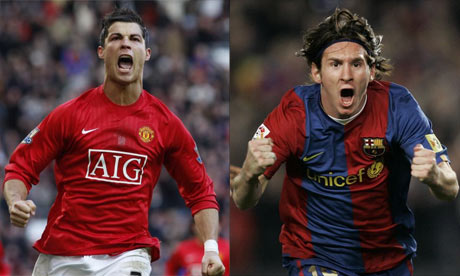
Messi vs. Ronaldo

[One programming note: with football and Signing Day over, the NBA in a bit of a lull, and baseball in the "what does Jeter think of A-Rod!?!" silly season, we're probably going to be a little footie heavy over the next several weeks. With the Champions League about to heat up, this is as good a time as any to starting picking up with soccer. To those of you who are new readers, I recognize that a detailed discussion about Barcelona's options at the defensive midfield spot isn't exactly an Atlanta sports issue. I've completely transitioned from listening to sports talk radio to the World Soccer Daily podcast on my iPod in the 40 minutes or so that I'm commuting to and from work each day, so I have soccer on the brain a lot more than anything else sports related. My apologies to the readers who don't like soccer. I promise the occasional college football, Hawks, and Braves post when a subject strikes my fancy.]

There is some debate as to the best player in the world right now between these two guys:


Here is the debate hashed out last spring when the two players met in the Champions League semifinal. Here is a 76-page thread on the subject at Big Soccer.

You won't be surprised that a Barca supporter like me would come out on the Messi side of the debate. Because we like lists, here are the reasons why:

1. Messi is better at creating goals. When arguing first, one should always start with the positive case for one's proposition. When arguing second, one should negate the opponent's best or most dangerous argument right off the bat. Because I like rebutting, I'll start with the primary argument for Ronaldo: he is bigger and can score with his head. That's a little like saying that a Jeep is better than a Ferrari for driving across the country because the Jeep can go off road. To quote Bob Dylan in "Lay Lady Lay" (the Hard Rain version), who really cares? To quote Dietrich from Raiders of the Lost Ark, only your mission for der Fuhrer matters. Does the player produce goals for his team by scoring them himself, by setting up his teammates, and by attracting defenders to create open space? The means don't matter as long as the end entails the ball in the back of the net. Right foot, left foot, head, knee, hands (if you're Argentine), they all look the same in the dark. Put another way, Maradona couldn't score with his head, but his reputation seems pretty secure.

This season, Messi has 25 goals in 23 starts for Barcelona. In his ballyhooed 2007-08, Ronaldo had 42 goals in 45 starts for Manchester United. Messi is on pace to beat Ronaldo for goals, regardless of the fact that his mop top rarely makes contact with the ball. Messi has 13 assists, which is five more than Ronaldo scored in the entirety of his 2007-08. Leo is a better passer, full stop. So, let's ask this question again: who creates more goals?

2. Messi's skills translate better against top opponents. The rap against Ronaldo that he's not a big game player should have been somewhat dispelled by his goal in the Champions League Final last May, not to mention his fine performance in the road leg against Roma in the quarterfinals. That said, Messi's skills are more useful against a great opponent. Quality defenses will close down the space afforded to attacking players. Messi's primary skill - a ridiculous ability to dribble in tight spaces with the ball attached to his boot - comes in handy in the conditions that a great player will face against a big opponent. Though a fine dribbler, Ronaldo is more noted for galloping into space with the ball. He doesn't have Messi's ability to get around in a phone booth. To Ronaldo's credit, his heading ability does come in handy against good defenses.

3. Messi is more valuable. The gnawing concern that I and most Barca fans have about the current version of the Blaugrana is that they are Messi-dependent. On a number of occasions, Barca have looked mortal without Leo and then dominant as soon as the Flea has come onto the pitch.

Exhibit A: at Shakhtar Donetsk in the Champions League, Barca trails 1-0, Messi comes on and scores twice, and Barca wins 2-1.

Exhibit B: home against Basel in the Champions League, Barca cannot break down a poor Basel side until Messi comes on and promptly scores. The game finishes 1-1.

Exhibit C: at Racing Santander in La Liga, Barca trails 1-0, Messi comes on and scores twice, and Barca wins 2-1.

Exhibit D: at Real Betis in La Liga, Barca trails 2-1, Messi comes on and Barca equalizes in a 2-2 draw.

Messi's not only playing for the best team in the world, but he is essential to their success. Barca are full of great players, but one is especially useful. The uncomfortable conclusion for me is that Barca are very vulnerable to a Messi injury. In fairness, it must be said that Ronaldo is bigger and more durable than Messi. On the other hand, Messi is far less likely to miss a game with knob rot. (HT: Gareth Keenan.)

4. Messi is younger. This one is self-explanatory. A 21-year old dominating is a little more impressive than a 23-year old dominating.

5. Ronaldo is a complete prat. Google agrees 75,800 times. Cristiano spent the summer whinging about being a slave and doing all he could to force a transfer to Real Madrid, where he will fit in perfectly. He can be a black hole with the ball. He dives at the drop of a hat and immediately looks to the ref upon contact with the ground. He poses like a fucking model before taking free kicks. If we're comparing Messi and Ronaldo, shouldn't Messi's ability to refrain from being a chemistry-killing ass matter? After the Ronaldinho flame-out, I'm quite conscious of the importance of having unassuming guys who just want to play as opposed to hedonists with too much product in their hair.

Tuesday, February 17, 2009

Taking Stock of the Hawks after the All-star Break

1. Overall, if you would have told me before the season that the Hawks would be 31-21 and firmly in the #4 spot in the East, I would have been overjoyed. The consensus before the season was that the team would be in danger of not making the playoffs, in light of the fact that they only won 37 games in 2007-08 and several non-playoff teams in the East had gotten better, namely the Sixers and the Bulls. The Hawks are on pace for 49 wins and their record is consistent with their scoring margin, so it cannot be said that the team has been especially lucky. I was a tad skeptical coming into the year because of Josh Childress's departure and the retention of Mike Woodson, but everything has worked out. The young players have developed, the bench hasn't been the disaster that we feared, and Mike Bibby is having a career year.

2. What do the Hawks do well? According to the numbers, they shoot the ball well, they don't turn it over, and they have a good assist rate. Does that sound like a team whose point guard is having an outstanding season? What do the Hawks not do well? Rebound. The Hawks are an above-average offensive team and an average defensive team, but they struggle to get rebounds on either end. Does that sound like a team playing a power forward at center? Or a team with only one quality reserve big man (Zaza)? Oh, and the Hawks are also 29th in the NBA in free throw percentage, which is very hard to explain for a team with a number of good shooters. The primary culprit has been Josh Smith, who gets to the line more than anyone else on the team (good!), but is shooting a woeful 58% (bad!), which is well below his career average.

3. And speaking of our local talent/enigma, Smith has shot the ball better this year than he has in years past, but all of his other numbers - blocks, rebound rate, assist rate - have gone down slightly. It is worth noting that Smith has the second-best plus-minus among the Hawks' regulars. Maybe we should see his performance this season as a "less is more" situation? His scoring, assists, and turnovers are down because his teammates are seeing more of the ball (and why not with Marvin Williams and Bibby having good scoring years?), so maybe Josh is a slightly more efficient player?

4. If I had to point at one reason why the Hawks are where they are, it would be Mike Bibby. Take a gander at these numbers. The Hawks rank in the top ten in the NBA at two positions; they get the sixth best production at shooting guard and the seventh best production at point guard. Bibby shoots the ball well, his assist rate is good, and he never turns it over. His performance has created an interesting dilemma for the Hawks in the off-season. Do they re-sign a player coming off of a great year (in a contract push) who is in the decline phase of his career? As with most free agent topics, the question comes down to the money and the length of the contract.

5. One thought on the rebounding issue: Zaza is a better rebounder than Horford. In light of that fact, it's not especially surprising that the Hawks' best unit (and the fifth best unit in the NBA) is the Bibby-Johnson-Evans-Smith-Pachulia lineup. There are major sample size issues with that lineup, but it would be worth Mike Woodson giving it a little more time to test it. With the back court scoring so well, it stands to reason that the Hawks putting their best defensive/rebounding front line on the court would work out.

6. This stat is, without a doubt, the most surprising one of the season for the Hawks. Not only has the bench not been the disaster that John Hollinger and others predicted before the year, but it's actually been a net positive and ranks 11th in the league in plus/minus. Interestingly, the Hawks' bench has played the second fewest minutes of any NBA bench, but they are third in points per possession. So here's the question: is Mike Woodson making a mistake by not using an asset enough or is that asset valuable because he's using it sparingly. In any event, it would be worthwhile for Woodson to dial back on the starters' minutes a little in the coming weeks, especially if the team has a solid lead for the #4 spot in the East.

7. Because I won't stop being contrary and pointing out that Billy Knight wasn't a bad GM (despite the Chris Paul mistake), note that the Hawks have three of Bill Simmons' top 40 players and none of his 25 worst contracts.

Friday, February 13, 2009

Welcome to the Dark Side, Mark Bradley

If this is what we can expect from Mark Bradley now that he has made the move to blogging, then the future just got a little brighter. Complaint about the media deifying a figure for BS reasons? Check! Use of data to support the argument? Check! Sufficient levels of snark? Check! Insult directed to Peter King? Check! All Mark is missing is a back-handed joke at King's weight and he'll truly be ready for a Darth prefix on his name.

Now, if Mark can just moderate his tendency to make excessively optimistic predictions about the local teams. We don't need the burden of a "Hawks over Celtics in the second round of the playoffs" jinx.

How about a Fourth Reason

The audience for USA-Mexico on Univision dwarfed the audience for Duke-Carolina on ESPN.

You have to appreciate the passion of Mexican futbol fans. El Tri are playing miserably right now. They're coached by Sven Goran Eriksson, who is most noted for an inability to beat Big Phil Scolari. Eriksson has one foot out the door already. Mexico's captain starts for Barcelona and was last seen getting red-carded in Santander, a feat that he repeated on Wednesday night. Despite all of their struggles, Mexicans turned on their TVs in droves to watch the match against El Tri's arch-rival. You have to admire that loyalty.

I'd be very interested to know what ESPN's upper management thinks of those numbers. Duke-UNC is supposed to be the pinnacle of the college basketball regular season, but it just drew a little more than half the audience of a World Cup qualifying match. Duke-UNC's 3.3 million viewers was also a little more than half of the audience for the Cavs-Lakers game on Sunday, despite the fact that the Blue Devils and the Tar Heels were both in the top five coming into the game. I understand that college basketball is a valuable property to fill up airtime, but how much value is bound up in a high-volume product that doesn't get ratings? I don't know what the alternative is. It isn't as if ESPN can put hockey games on and get bigger numbers. My overall point is that college basketball's regular season doesn't move the needle and it probably gets more attention from ESPN than the ratings can justify.

Wednesday, February 11, 2009

Top Three Reasons why UNC-Duke isn't a Truly Great Rivalry

ESPN's endless hype compels me to make three quick points:

1. Duke and Carolina aren't playing for anything. They're both going to be in the tournament, so they're basically playing for a slightly better geographic placement. Still my beating heart. Even if most fans cared about the college basketball regular season, which they don't because the tournament has killed it, the game still wouldn't be for big stakes because the ACC pretentiously declares the winner of its postseason tournament to be the champion. Thus, the Heels and Devils aren't even playing for a championship. Instead, they're playing for the right to play Maryland instead of Boston College in the first round of the tournament. Texas-Oklahoma this is not. Call me if they meet in the ACC Tournament Final.

2. There are no Duke fans in the State of North Carolina. Or so I've been told by every friend I've ever had from UNC. The jokes about the University of New Jersey at Durham are funny and all, but they do detract from the incessant "they're eight miles apart!" bullshit. Duke is a little oasis of Connecticutians in a sea of Tar Heel and Wolfpack fans. If this isn't a border war and it isn't a civil war, then what the hell is it?

3. The entire country (save for those of us who are luckily in the Raycom footprint) has to watch the game on mute. You can't seriously think that anyone can listen to Dick Vitale perform verbal fellatio on these two admittedly fine programs for more than five minutes without hitting the mute button. And for all the talk about the game's atmosphere, how much of that comes across when confronted with a choice between silence and the brutal rape of one's own ear drums by the man who personifies the term obnoxious yankee?

I watched USA-Mexico tonight, followed by Juno. Piss off, I'm a man and I can do what I want.

Friday, February 06, 2009

Post-Signing Day Thoughts

1. I cut myself shaving and got lifeblood all over my undershirt. Seriously, has any person at any time in human history ever used the word "lifeblood" in a sentence in which they were not talking about recruiting?

2. I was composing this post in the shower this morning and wanted to start by saying that Nick Saban's two #1 classes have had everything but an elite quarterback, but Dr. Saturday had beaten me to it. To me, there are a few possibilities. One is that there hasn't been an elite quarterback in Saban/Alabama's recruiting sweet spot: Alabama, Mississippi, Memphis, and the Florida Panhandle. A second possibility is that Saban is slightly hamstrung in recruiting a quarterback because his offensive systems aren't as attractive to high school players and he doesn't have a track record of putting quarterbacks in the NFL. A third possibility is that Saban doesn't prioritize recruiting quarterbacks in the same way that he prioritizes recruiting other positions because he's won with game managers. With quarterbacks, he could be a Bobby Knight who would rather have a player who follows instructions and runs a system than a headstrong talent who is likely to freelance.

Regardless of the explanation, Saban's offenses are going to need to be a little better in order for Alabama to truly achieve parity with Florida. We know that Meyer's offenses and Saban's defenses will be top shelf, so it's quite possible that SEC titles in the near future will come down to whether Meyer's weak suit is better than Saban's. As long as Meyer has Charlie Strong and a pile of defensive talent, his defenses will be almost as good as his offenses. Saban is assembling excellent talent on offense, but if he is going to continue to go the conventional running/play-action route with game manager quarterbacks, he is going to be half a step behind Florida.

2a. All that said, Saban is absolutely living up to the description from Michael Lewis's The Blind Side of being a super recruiter. I always thought that Alabama was at a disadvantage compared to Florida, Georgia, and LSU because it's local talent base isn't as good and they have to share some of it with Auburn. What I'm realizing is that there is more talent in Alabama than I had previously thought and Saban is getting all of it. If Auburn's decision-makers knew that a second straight whitewash of in-state recruiting was coming, then their decision to fire Tuberville makes a little more sense. I still don't agree with it, but it's not as irrational as I first thought.

3. If you want an illustration of the disparity in talent between the Southeast and the Upper Midwest, check out the number of four- and five-star recruits in the following states:

Florida - 61
Georgia - 22
Louisiana - 14
Alabama - 12

Ohio - 16
Michigan - 11
Pennsylvania - 9
Illinois - 9

These numbers come from Rivals, but one can reach a similar conclusion from Scout's or ESPN's rankings.

Yeah, down year in the Midwest, blah blah blah blah. What you're seeing is the effect of population draining from the Upper Midwest to the Sunbelt. I'm going to write a lot more on this subject over the summer, but one subject that I specifically want to cover is whether the socio-economic groups that are moving South are more likely to be the same groups that tend to produce blue chip prospects. What you're also seeing is a justification for Michigan going with Rich Rodriguez because Michigan needs a coach who: (1) runs a specialized system that can be an equalizing factor for lesser talent; and (2) can recruit the Sunbelt.

Also, I have to begrudgingly give some respect to Jim Tressel for pulling a second straight top five class out of a region that doesn't produce a ton of talent. In the past two years, Ohio State has pulled 19 recruits rated by Rivals as a 5.9 or higher; 11 have come from outside of Ohio. The stereotype of Ohio State as being a plodding Midwestern team might be apt in terms of scheme, but it will not be true in terms of talent in the coming years as these two classes emerge. If Ohio State keeps losing to Sunbelt teams, it won't be because of a lack of speed.

4. I liked Georgia's class, although I would have liked to see more than three offensive linemen in light of the problems that Georgia has been having at the position. I'm excited to see what Richt will do with Aaron Murray, who is a bit more mobile than the average Richt quarterback (save for D.J. Shockley). I'm also excited to see what Georgia can do with 6'5 Marlon Brown opposite 6'4 A.J. Green. How many teams have two big corners? And is there anyone who isn't penciling Branden Smith in for a starting spot by the end of September?

5. If you wonder whether Notre Dame still has pull in the media, look at the way that ESPN treated Manti Te'o signing with the Irish - updates on ESPN radio, front page of ESPN.com, mention on SportsCenter - with other top players who announced on Signing Day, such as ESPN's #1 DB (Dre Kirkpatrick) and #1 RB (Trent Richardson), both of whom signed with Alabama.

6. There is no other way to put this: Lane Kiffin looks like an absolute amateur when he rips on Urban Meyer for an alleged NCAA violation and then has to apologize because there was no violation. At first, I simply thought that Kiffin was going to get shown up by Florida in Gainesville in September. Now, Kiffin resembles a little kid who was scolded by his elders and then put in his place. Andy Staples nails it:

If Kiffin didn't intend to offend Meyer by calling him a cheater, what did he intend to do? Kiffin had better hope his coaching staff -- which is excellent, by the way -- whips the 5-7 team he inherited into shape by Sept. 19. That's when the Vols visit The Swamp, where Meyer and the defending national champs will be waiting. And in case Kiffin isn't clear on how Meyer handles slights, he can call Georgia's Mark Richt. Richt's players flooded the end zone on the first touchdown of the Bulldogs' victory against the Gators in 2007. Despite the fact that Richt spent the next 12 months apologizing for the incident, Meyer still burned two late timeouts to rub in a 49-10 beatdown when the teams met again. If Meyer humiliated Richt, a coach he respects, for that transgression, imagine what he wants to do to Kiffin.


My hatred for Tennessee had dwindled over the past several years because they were no longer good enough to despise, but Kiffin has managed to renew all of those feelings in a short amount of time.

7. Are we beginning to see the first signs of Pac Ten programs starting to compete with USC in recruiting? G-d forbid! After Signing Day 2007, I wrote this:

Pac Ten programs not named USC took two of the top ten players in California this year. They took one of the top ten in 2006. They took three of the top ten in 2005. They took four of the top ten in 2004. Thus, in a four-year period, USC has signed 25 of the players on the California top ten list and the rest of the conference has signed ten. The argument that SEC fans should be making to belittle USC's success is not that USC would go 8-3 in the SEC, a totally unsupportable claim given the ridiculous amounts of talent that USC deploys. Instead, the argument should be that USC benefits from the fact that no one else on the West Coast can recruit worth a damn.


This year, USC signed four of the top ten players in California and the rest of the conference signed five. In USC's defense, they did sign three of the four five-star players in-state and the fourth decommitted on Signing Day. We shouldn't shed any tears for USC, as they will still be significantly more talented than any other team in the Pac Ten for the foreseeable future.

Here's a little stat to illustrate that point: Rivals' database goes back to 2002. In the eight recruiting classes covered in the database, USC has finished in the top ten in the last seven seasons after finishing 13th in 2002. Collectively, the other nine teams in the Pac Ten have three top ten finishes in that eight-year period: UCLA's #9 finishes in 2002 and 2004 and Cal's #9 finish in 2005. USC's last seven recruiting classes have all finished higher than any recruiting class by any Pac Ten program over the past eight years. That's why it's hard for me to take the Pac Ten seriously. The conference may be well-coached, but the aggregate level of talent is poor outside of one major program. Hopefully, this year is a step towards the other nine members of the conference doing a little better on Signing Day.

Monday, February 02, 2009

This One Goes to 11

1. Remember when there was serious concern about the Super Bowl being an annual blowout? For whatever reason, the last two Super Bowls have been classics and there hasn't been an uncompetitive game since the Tampa-Oakland Super Bowl ending the 2002 season. The only factor detracting from this game were the constant penalties, which annoyingly broke up the flow of the action. I prefer not to see every other pass play get called back for holding. That said, it would stand to reason that a Pittsburgh game would have a ton of holding penalties because the Steelers pair a bad offensive line with two unblockable outside linebackers. Beyond the holding penalties, there were several penalties in the game that resulted from players just being stupid and forcing the hands of the officials. Roughing the holder? Punching a prone blocker after a punt is away? Really?

2. I will never again listen to an NFL talking head pronounce that you can't win without running the ball. Arizona and Pittsburgh couldn't run their way out of paper bags. Pittsburgh was painful to watch in the red zone. The game wouldn't have been competitive if the Steelers could run the ball inside the five. Maybe they'll make some use of Dennis Dixon in those situations next year?

3. Troy Polamalu routinely makes plays that cause me to exclaim "how did he know that the ball was going there?" He has terrific instincts and uses those instincts to show up in places where he is least expected. That said, the Larry Fitzgerald touchdown to give the Cardinals the lead showed the flipside of Polamalu's freelancing. Pittsburgh was in cover-two and Polamalu decided to jump an outside route. Unless Dick Lebeau coaches the cover-two different than every other coach on the planet, Polamalu was not following instructions. Thus, the middle of the field opened like the Red Sea and Fitzgerald scored on what would have been one of the most famous plays in NFL history if not for Pitssburgh's subsequent heroics. Polamalu also whiffed on a couple tackles during the game. That said, I'd bet that he was heavily involved in the defensive effort that made Fitzgerald a spectator for three quarters.

4. Arizona seemed way too scared of Pittsburgh's pass rush in the first three quarters. I get that the Steelers' blitzes are hard to block, but what was with all the running plays and short passes?

5. Did anyone else see James Harrison's interception at the end of the first half and immediately think of Florida intercepting Sam Bradford at the end of the first half of the BCS National Championship Game? The scores were almost identical (7-7 vs. 10-7), the route was the same (slant to the left), and both passes were picked, swinging momentum away from the team with the ball. Arizona could not have enjoyed the two-hour halftime with the taste of that pick six in their mouths.

6. I've been watching the Sunday night English Premier League highlight show for months. The highlights of just about every game are followed by interviews with the two managers, which inevitably involve the losing manager bitching about a penalty, a free kick, a card, and/or the ref's lack of hair. (They all imitate Sir Alex, who is the master of this tactic.) With that context in mind, it was refreshing to watch Ken Whisenhunt acknowledge after the game that Santonio Holmes made a great catch to win the game, despite the fact that the winning touchdown was a close call.

6a. What is it with Steelers receivers and amazing catches in the Super Bowl?

7. Ben Roethlisberger is truly the perfect quarterback for this Steelers team. Specifically, he's great at making late throws after buying time with his feet and his size. This is a necessity with a suspect offensive line. The sacks that he takes as a result of holding onto the ball are more than outweighed by the big plays that he creates by forcing a secondary to cover for five seconds.

8. With every big play that Darnell Dockett and Lawrence Timmons made in the game, I was reminded of Greg Easterbrook proclaiming that Florida State linemen generally and Timmons specifically are not worth high picks in the Draft.

9. Jeff Hartings' holding call in the end zone mooted the issue, but Pittsburgh would have been smart to take an intentional safety if they would have been confronted with fourth down from their one one-yard line. The difference between a four- and six-point lead in that spot pales in comparison to 25 yards of field position. Given Mike Tomlin's strategic conservatism (see: the field goal on the opening possession), I doubt that he would have done so, but that would have been the right call in terms of risk and reward.

10. Pittsburgh's final play on offense was a catch by an Ohio State product and its
final play on defense was a sack and forced fumble by a Michigan product. Anecdotally, that's a piece of evidence against my theory that Big Ten teams need to coach as if they are operating with a talent deficit.

10a. Speaking of the final defensive play, there ought to be a rule that any celebration penalty should be ignored if the play that led to the celebration is overturned on review. Pittsburgh would have been put in a tough position if the call would have been overturned and Arizona would have gotten a 15-yard bonus tacked on to the play. And speaking of celebration calls, it was amusing that the refs called everything in the game, but missed Santonio Holmes using the ball as a prop (an automatic 15-yard penalty in the No Fun League) after his touchdown catch. You think that Arizona would have felt better about their chances if Pittsburgh were kicking off from the 15?

11. Can we pass a rule that Kurt Warner has to play in every Super Bowl?

MESSIah


Pep Guardiola started Messi on the bench yesterday because Messi had played midweek against Espanyol in the Copa del Rey quarterfinals. An hour in, Barca hadn't created much in the way of offense and were trailing 1-0 because of an idiotic decision by Rafa Marquez to attempt a slide tackle from behind in the box. (I do not trust Marquez at all. If Barca get knocked out of the Champions League, I'm willing to bet right now that he and/or Gerard Pique will be prominently involved.) Messi comes on and promptly scores twice to give the Blaugrana their ninth straight win on the road in La Liga. The evidence that Barca is dependent on Messi continues to grow.

Super Bowl thoughts are coming...