Showing posts with label Euro '08. Show all posts

Sunday, June 29, 2008

Boots of Spanish Leather


After every pundit reminded us that form in the group stages doesn't matter, that getting outplayed by shorthanded Turkey for long stretches doesn't matter, that Germany win these sorts of tournaments and Spain do not, and that German size the strength would prevail over the smaller Spaniards, Spain won the European title with a 1-0 win that flattered their opponents. In the end, talent won. The ability to control, dribble, and pass won. The better team won.

In my heart of hearts, I thought before the game that Spain had the better team, but that Germany would play their best and sneak out a win. I bought into the "Spain never win anything" line of thinking (thanks, Dad and Klinsi), forgetting that the last two Super Bowls were won by Manning brothers and two of the last four World Series were won by the Red Sox. It dawned on me during the national anthems that the Germans were the side full of second-place specialists. The Germans had Jens Lehmann in net, the same Mad Jens who got red carded minutes into his only Champions League Final. The Germans had Miroslav Klose up front, a striker most noted for pouring in the goals against Saudi Arabia and then fading at crunch time. The Germans had Michael Ballack, a famous "almost" player (although that reputation is not entirely his fault). The last time that Ballack and Iker Casillas were on the same pitch for a major final, Casillas played out of his mind in the later stages to preserve a Champions League title for Real Madrid against Bayer Leverkusen. Spain's defense was marshaled by Carles Puyol, who captained a Champions League winner himself. Their attack was led by Fernando Torres, who scored big goal after big goal for Liverpool in the Champions League this year. The reputations coming into the game were Spain as bottlers and Germany as clutch, but the individual players were the reverse.

No, I will not let you borrow my Champions League medal.

And so it played out. After Puyol covered for Sergio Ramos's only goof of the match in the fourth minute and Hitzlsperger hit the ball right at Casillas in the ninth minute, Spain dominated the rest of the way. They had just about every good chance. The back line handled Germany's forwards easily (Sergio Ramos deserves special credit for his work negating Lukas Podolski), Marco Senna won everything in the midfield, Xavi was a perfect fulcrum, and the front men consistently made intelligent runs. Iniesta was a constant danger man despite playing out of position (his ball across the box for David Silva that Silva then skied over was particularly sublime) and Torres, well, he was Torres.

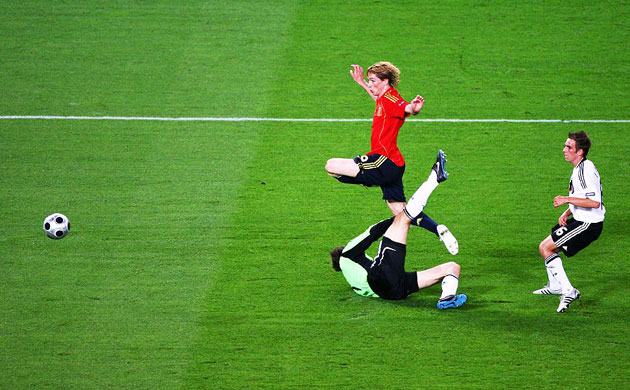
Torres's goal demonstrated the best about his game, as well as Xavi's. Xavi is the master of control and accurate passing. He popped up in the middle, took the ball, and immediately put it into Torres's path. Torres then used his speed and strength to overpower Phillip Lahm for the ball in the box (naturally, the bigger Germans gave up the goal because of their one diminutive player) and push a perfect shot over Lehmann and into the net. Lehmann was always a worry for the Germans and it must be said that he didn't need to come charging out of his net on this occasion. He's now lost a Champions League Final and a Euro final by being too aggressive. As for Torres, his goal was the second occasion when he had been more physical than the German defenders, with the first being his awesome effort to head the ball onto the base of the post when Mertesacker was right on him.

As for the Germans, their physical prowess didn't pay dividends for two main reasons. First, they wasted a number of opportunities with poor deliveries from free kicks. Bastian Schweinsteiger's evil twin had a poor game. Second, Iker Casillas controlled his area perfectly.

Random thoughts:

1. How amusing that Spain finally win the big one after they banish Raul. I'm lovin' that.

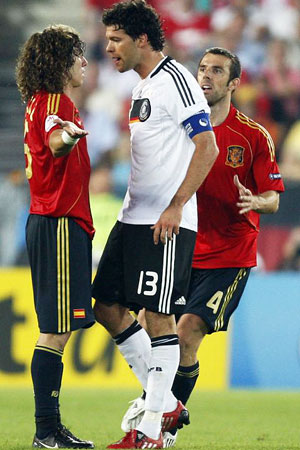
2. I was really disappointed by Michael Ballack. He had a few good moment, but for a guy who I've always liked and viewed as a big game player, he had a poor match. He made a number of late tackles as Andy Gray astutely noted and he didn't have the sort of impact on the game that we thought. He seemed to be frustrated and pressing. Senna and Xavi won their battle with Ballack decisively, which goes a long way to explaining why Spain dominated the proceedings. Then again, if not for a deflection from Sergio Ramos or a shot into the side netting, we might be writing much nicer things about Ballack. The difference between "he's clutch" and "he choked" is ludicrously small.

2a. I don't know if it's quite fair to blame Ballack. After all, he was a little better than Cesc Fabregas, his equivalent on the Spanish side. To me, the match was decided by the Spanish getting more from Xavi and Senna than the Germans did from Hitzlsperger and Frings. Spain won in the midfield and then Iniesta and Torres had more success against the weaker German back line than Klose, Podolski, and Schweini did against a superior Spanish back line. The Spanish attackers got more of the ball because of their midfield and they were more likely to turn possession into chances.

3. It's odd that Spain broke their international hoodoo after a year in which just about every Spanish analyst proclaimed La Liga to be a disappointment.

4. I'm sure they will have noticed in Spain that the last challenge of the match was won by Barcelona's captain and then the last kick of the match was made by Real Madrid's captain.

5. It's hard to put into words what a breath of fresh air Euro '08 was. Euro '04 was won by the Greeks boring a series of superior opponents into submission and winning matches 1-0 when they converted their only chance of each game. The 2006 World Cup came down to a final between France and Italy, a ringing endorsement for conservative football. Euro '08, in contrast, was won by a team of real skill and class. For the most part, Spain came up against opponents who came to play proper football themselves, thus allowing the Spanish the space to show off their merits. The one exception, predictably, was Italy. The few anti-football sides at this tournament were shown the door early, which led to some really good knock-out games. The one effective way to deal with the Spanish short-passing style (when played by quality players) is the "park the bus" approach that Sir Alex Ferguson took at the Nou Camp. Thankfully, only Italy took this approach this year. The tournament was thus won by the best team.

Tuesday, June 24, 2008

La Furia!

Thoughts on the Bad Result:

1. To me, the Netherlands-Russia game was decided by the the Russians' domination in the midfield. I wish I could point to whatever tactical stratagem Guus Hiddink used to make this happen, but I can't. Everyone knew going into the tournament that the Dutch defense was weak, but they could succeed if they were properly screened by Nigel de Jong and Orlando Engelaar and if the Dutch maintained possession. Neither happened yesterday.

2. Andrei Arshavin reminds me a little of Messi in terms of his skills with the ball. He's not quite as fast, but I think his final pass is a little better. Messi has shown some terrific touches and shots before, but I don't remember him hitting anything quite so subtle as Arshavin's cross for the winning goal. Keep in mind that Arshavin is 27 and therefore in his prime, so whichever club pays through the nose for him is paying for his prime and then for the decline phase of his career. That club also won't know know how someone is going to respond when they've cashed in. All that said, the club that signs him is getting the best player in the tournament. The early signs indicate that Arshavin wants to play out the Messi comparison as a teammate.

Without revealing names, Arshavin claims to know of offers from England, but insists his dream is to play in La Liga. "I know that I have offers from England and Germany, but what I would really like is to play in the Spanish League, in the Primera Division," he told the Spanish newspaper AS. "It's the championship I've always followed, I like the football they play there. But, at the moment, I don't have any offers from Spain."

Those offers may soon arrive with Arshavin having been heavily linked to Barcelona following his starring role in Russia's 3-1 beating of Holland in Saturday's quarter-final. Those reports were sparked by comments from the Russian Football Federation president Vitaly Butko, who on Sunday claimed that the player has his heart set on a move to Camp Nou.


I must admit that the idea of Messi on the right and Arshavin on the left of a 4-3-3 is quite appealing. On a related note, I breathe oxygen.

3. In retrospect, Russia's success shouldn't be a surprise. The backbone of this team comes from the Zenit side that destroyed a good Bayern Munich side en route to winning the UEFA Cup. Zenit were the only side in the tournament that could break down Rangers' defensive wall. Russia has excellent players coached by the best international team coach around. Sorry old England ought to feel a smidge better knowing that it was knocked out in qualifying by two teams that are better than their names.

4. I'm not sure why, but my frustration with the Dutch focused on Robin van Persie yesterday. He was totally useless, culminating in knocking a free kick miles over from 20 yards when everyone assumed that Wesley Sneijder, a superior player, was going to shoot. Ernst Bouwes had exactly the same thoughts that I did watching the second half:

One scene in the quarter-final last Saturday night is enough to illustrate the difference between the start and the end of the tournament for the Dutch. In the 72nd minute Kolodin gives away a free-kick just outside his own box. Several cameras depict the concentration on the face of Wesley Sneijder as he waits for the referee to negotiate the Russian wall to the required distance.

The eyes of the world are on him, while commentators reminisce in their commentary box how the Real Madrid-ace has scored from a similar position in the qualifier against Bulgaria and so many times for his clubs. Curling the ball over the wall in the lower left corner of the goal is his trademark. The Russian keeper Akinfeev has already moved to the other side, which increases his chances. Like a high jumper Sneijder knows exactly from experience how many steps he has to take and at which speed to find the perfect mix between the tempo of the ball and the curve.

The referee blows his whistle. Sneijder's brain is sending commands to the muscles in his legs to start moving. In that fraction of a second the eyes of the former Ajax-player notice something strange. His team-mate Robin van Persie hacks the ball unceremoniously into the stand and returns to his position, somewhere undefined on the right flank, where he has created his own Bermuda Triangle for Dutch possession of the ball.

Sneijder is rooted on his spot, just outside the box, fuming, considering whether he can still catch the night train into Germany from the Basel Hauptbahnhof if he leaves the stadium immediately. It takes him more than a handful of seconds to regain his calm and amble into the already crowded midfield.

It is the preliminary episode of a frustrating night for the man who was about to become the star of the tournament, but would end the campaign shouting abuse to everyone around him, seemingly the last one of his team who cared. His team-mates had mostly faded away and resigned themselves to an early exit.


4a. Has there ever been an Arsenal player under Wenger who has lived up to his club reputation for his national team? I'm not sold on this theory, but it's kicking around in my head right now. I'm wondering if players don't look much better than they actually are when playing for Wenger because of his coaching acumen. By the same token, I ought to be wary about Barca signing Arshavin for big money after Hiddink made him look good, but the fact that Arshavin was so good for Zenit is comforting.

5. Tommy Smyth drove me crazy during the match. I seriously think he has poor eyesight. I've never seen someone look at so many replays and simply get them wrong. Andy Gray has exposed all of Smyth's shortcomings. You can see why the two of them don't get along when they're in the studio together.

6. It's sad to me that Edwin van der Sar went out with a ball being deflected between his legs. He played an outstanding game and will be missed by the Dutch. He covered for a lot of defensive shortcomings. Conversely, Igor Akinfeev is a liability for the Russians. Rafael van der Vaart repeatedly sent free kicks right into Russia's six-yard box and Akinfeev was just letting them pass through. The Dutch could have scored several goals from set pieces if their unmarked attackers could have gotten touches on the ball. If the Russians play Germany in the final, the Germans will kill the Russians with set pieces. Ballack and Klose will have a field day. And speaking of our friends in Deutchland...

6a. Isn't it typical that the Germans draw a battered and weakened Turkey side in the semifinal? Germany had an easy qualifying group, the easiest of the four groups then the 16-team draw was made, and now they play a side that won't have enough warm bodies to make its full three subs. Oh, and the Germans are playing right across their border in a pair of German-speaking countries. (Yes, I know that the Swiss speak a number of languages.) At the rate the tournament is going, Russia will beat Spain in the semis and then their team bus will fall in a ravine, leaving the Germans to be opposed in the final by the 1988 USSR side that lost the European Championship Final in Munich.

7. Even in defeat, it's a credit to Dutch football that they were beaten by one Dutch coach and a bunch of players who play at Zenit for a second Dutch coach.

Thoughts on the Good Result:

1. Anyone who thought that Spain were going to win in penalties, raise your hands. Spain haven't made a major semifinal in 24 years. The Spanish have a record in penalties that rivals that of England and Holland. They has been eliminated three times in penalties on June 22. (Incidentally, couldn't UEFA have finagled a way for Germany and Russia to meet in a quarterfinal on June 22? You should be warned that I will be out of control with the Eastern Front jokes if those two teams meet in the final. I was all ready to make a reference to Spain's blown opportunities on Sunday being not unlike the Armada failing to attack the English fleet as it was leaving Plymouth in 1588...and the Eastern Front is in my wheelhouse in a way that 16th century naval engagements never will be.) The Spanish hate the Italians for playing boring, defensive soccer and still getting results, so losing after a 0-0 draw in penalties would have been perfect for Spain. The Spanish also hate the Italians for being lucky, so losing after a shot squirted away from Gigi Buffon and nestled against the post would be poetic.

With all of that context going against them, Spain performed beautifully in penalties. It helps have Saint Iker in goal. I can't get myself to dislike this icon of Real Madrid. He's not annoying in any way and as a former (inept) keeper, I really appreciate the way that Casillas goes about his business. Andy Gray made an astute comparison between Casillas confidently claiming a cross in his area as opposed to the way that Akinfeev let balls ping around his box. Leave it to Gray to make a better observation about a game that Smyth actually called. Speaking of Gray...

2. I loved his attacks on Herbert Fandel. Once in a blue moon, Sir Alex Ferguson is right about something and his feelings about Fandel are spot on. He consistently missed fouls on the Spanish in or near the Italian penalty area. (You get the sense that Italy decided after a marginal penalty call went against them in the match against Romania that no ref would call anything against them in the box.) He also rewarded the Italians' play-acting whenever the Spanish broke for an attack.

3. I often defend Italian football as being unfairly criticized for being defensive and cynical, but the match on Sunday confirmed the stereotype. In contrast to Euro '04, this tournament has been karmically terrific in that all of the dour sides (Italy, France, Romania, and Greece) have been punished for their lack of imagination. Then again, how great can a tournament be if the Germans are going to win it?

4. Spain's attempts to beat down the Italians' wall reminded me of Barca's similarly unsuccessful attempts to beat down the wall that Manchester United put up in the two Champions League semifinals. Spain and Barca are similar in the respect that they play wonderful football based around short passes, but they don't have a Plan B when the opponent puts eight quality defenders between the ball and the goal. Spain needed to either present a credible threat of shooting from distance (and none of the Spanish players are really noted for that skill) or they needed to attack down the wings (and none of the Spanish players are noted as being great headers of the ball). None of the remaining sides in the tournament will set out the stall quite like the Italians did, so Spain should be able to do their thing going forward.

5. I demand that you acknowledge that Puyol played very well on Sunday!

6. Phil Ball's piece on the game is, as always, a must read. My favorite section:

The great thing about Sunday night's game is that the Spanish played it faithful to their own instincts about football, as did Italy to theirs. In the end, for a change, the gods of fortune got it right. When Senna's shot squirmed under Bufffon (just like Arconada's gaffe in 1984) the ball hit the post and nestled back into the keeper's arms. Luck, once again, seemed to be on the side of the pragmatists.

The referee was also doing his best to don a white shirt and officially proclaim himself Italy's 12th man. And as expected, Spain took possession of the game and tried to win it, whereas Italy made a few vague patterns in the centre of the field and tried to hoof the ball up to the awful Luca Toni, who looks even more awful when the service is poor.

Spain have now beaten the reigning European champions and the world champions in successive games, and looked miles better than either of them. At least they tried to play football. As the excellent football writer Santiago Segurola noted on Monday morning, Italy don't' even use the word 'football'. For them it's Calcio - 'something else' In a country so dedicated to the aesthetic as Italy is, football is something else for them - a war, a battle. As such, it doesn't matter how you do it. The beauty for them resides in the negativity, in the locking of the door.

But the Spanish are romantics, and prefer to indulge in beauty (or something approaching it) on the football pitch, given the relative messiness of their urban aesthetic. They would probably have imposed this philosophy before the penalty shoot-out if the appalling referee, Herbert Fandel, had possessed even the slightest notion of what constitutes a foul.

Seemingly obsessed by the notion that the Spanish are cheats, Fandel's assumption that the blatant fouls on Villa and Silva in the first half were anything but made no sense, particularly since if he really thought as much surely he should have booked both of them.

Spain were trying to win. It was Italy who were cheating - constantly interrupting the Spanish flow; whenever a player went down, he looked up carefully to see if an attack was forming, then rolled back over again to force the Spaniards to kick the ball out of play.

Surely, FIFA has the power and gumption to act on this sort of stuff? If a player recovers remarkably within 30 seconds of having required the play to stop, then surely he should be booked? It's not rocket science. The rule of kicking the ball out of play was only instituted in the 1990's to ensure that a player seriously injured could be attended to. Now it's just daft, and sides like Italy will always try to take advantage of the loophole.

Monday, June 16, 2008

Ernst Bouwes on the Dutch

I recommend Ernst Bouwes's take on the Dutch resurgence. A couple thoughts:

1. More grist for the notion that modern players are overcoached and there is an advantage to be gained by gaffers loosening the reins and letting their teams have some freedom. I first thought this when Chelsea started to put on good displays under Avram Grant. Holland's performance under van Basten is Exhibit B. This explanation also makes sense of the fact that the Dutch never produced this level under van Basten. Essentially, Marco tried to force Holland to play the 4-3-3 even though the personnel did not fit. The result were some uninpsiring performances for the first three years of his tenure. Liberated from pressure in his last tournament in charge of the Oranje, van Basten is listening to his players and giving them freedom. His coaching approach is more laid back, thus producing better football.

1a. It remains to be seen if a laid-back approach to tactics will work against a Scolari-coached team as opposed to teams coached by Domenech and Donadoni, neither of whom are especially good at what they do.

1b. The Dutch have already gained vengeance over the sides that knocked them out of the '96 and '00 tournaments. If the vengeance circle is to be completed, then they will have to vanquish Portugal, the side that knocked the Dutch out of Euro '04.

2. Irony alert: the Dutch have a tradition of playing the 4-3-3, which van Basten is violating. They also have a tradition of players: (1) inserting themselves into the coach's decisions; and (2) having freedom to move all over the pitch (hence the concept of Total Football). Van Basten has broken one tradition, but in so doing, has upheld others.

3. Wankdorf. Huh huh huh huh.

4. Bouwes is spot-on when he says that van Basten has figured out that the best way to protect a lead with his average back line is to pile more offensive pressure onto the opponent and get more goals. After 13 years of watching Lloyd Carr try to nurse narrow leads for obscene amounts of time by running the ball and trusting the defense, it's liberating to root for a side whose approach to protecting a 1-0 lead is to score three more goals in the second half.

4a. In case you were wondering whether my whining about Lloyd's policies and procedures with a lead would end after his retirement, the answer is "no."

Euro Overload

Holland-France

Yeah, I guess you could say that I enjoyed watching my favorite team in the tournament beat the crap out of my least favorite. I enjoyed being on the right end of a typically disinterested performance by Thierry Henry as opposed to having to root for the guy. (The fact that he interspersed one great finish in with 89 minutes of sulking just makes the sulking harder to take.) I enjoyed the excessively conservative French being totally exposed. Raymond Domenech, you were two goals down in the second half of a game you had to win or at least get a point. What the hell were you doing playing four defenders and two defensive midfielders for the entire second half? Did you enjoy the whole world realizing that you are an excessively defensive tool when Claude Makelele, the player you should have pulled off at the half and certainly when you were down 2-0, fluffed a shot in the box because, you know, he never shoots?

(One aside: in the same way that Roberto Donadoni goofed by deploying the entire AC Milan midfield after a bad season for the Rossoneri, Domemech goofed by deploying all of his Barcelona players in the opener against Romania after the Blaugrana were crap this year.)

Conversely, I loved Marco van Basten being rewarded for going for the jugular. Up a goal at the half, van Basten threw on Arjen Robben (and attacking winger) for Orlando Engelaar (a defensive midfielder). Robben promptly scored one and assisted a second in the second half. Euro '08 has been a terrific tournament and not just because my two favorite teams - Holland and Spain - have been playing well while my least favorite team - England - are watching from vacation. The tournament has been marked time and again by coaches being rewarded for going for the jugular, as opposed to getting a goal and then trying to make it stand up for an hour. After Greece bored the rest of the continent into submission four years ago, this is a useful tonic. Instead, the Cinderellas this time - Croatia and Turkey - have all advanced while playing attractive football. Yay for progress!

The ultimate sign of progress will be if doddering former powers Italy and France play out a meaningless game tomorrow because Romania are beating the Dutch. The match presents an interesting problem for Holland. On the one hand, they ought to try to win because it's the right thing to do. Strategically speaking, the best outcome for Holland would be to force Spain to play France or Italy, both of whom give the Spanish a complex. On the other hand, the Dutch must be concerned with injuries to key players, especially when a number of their attackers - van Nistlerooy, van Persie, Sneijder, and Robben - have been brittle this year. The second choice Dutch attacking four - Huntelaar, Robben, van Persie, and Affellay - would be more than enough to threaten Romania, but does van Basten risk the brittle Robben and van Persie, knowing that they are his super subs? And surely Marco wants a look at a keeper other than van der Sar since Edwin can't play forever.

Spain-Sweden

Spain have never been noted as the kind of team that can gut out a game in which they are playing below their best, so kudos for getting three points on Saturday. That said, the defense still looks shaky. I watch a fair amount of Real Madrid and I don't remember Sergio Ramos being this vulnerable as a defender, so maybe I need to be paying more attention. How he paid so little attention to a striker with Zlatan's reputation is beyond me. Also, Sweden showed future Spanish opponents the gameplan to negate La Furia: overload the middle and harass Xavi every time he gets the ball so he can't get the pendulum started. Sweden did a nice job of nullifying the Dutch. Of course, the fact that they had to sacrifice their own offensive prowess to do so meant that the worst that Spain would do in the game would be 1-1.

Russia-Greece

I think I speak for most of the non-Greek world in saying that I will shed no tears over the Greece being out of the tournament. The fact that they went out on a defensive blunder is fairly comical.

Turkey-Czech Republic

Simply one of the best games I've ever seen. The first half wasn't great, as the Czechs completely dominated and created all of the good chances. Whatever Fateh Terim said at the half must have worked because the second half was a completely different story, with the exception of the chances that the Czechs created when Turkey was down to ten men. A lot of attention has been devoted to Petr Cech's howler and it was a colossal mistake, but the larger picture is that Turkey was creating all the chances for most of the half. After the Turks got the goal to get back to 2-1, they were coming at the Czechs in waves, stringing great passes together on a consistent basis. Would the Czechs feel better if Cech wouldn't have fumbled a cross, but they would have surrendered the lead on Servet's free header minutes before. It's hard to say that Turkey did not deserve the equalizer, regardless of the way that it arrived. And then Nihat's winner was simply outstanding, both in terms of the timing of his run and the quality of the finish.

You think a Turkey-Germany semifinal might be interesting, given the number of Turks living in Germany?

Tuesday, June 10, 2008

Brilliant Oranje


In a tournament lacking for goals and marked by teams putting up six-man defensive walls in front of their keepers, Holland and Italy delivered the goods. OK, mainly Holland. The Dutch ripped Italy, scoring more goals in one game than Italy conceded in eight matches at World Cup 2006 (Italy's matches against Australia, Germany, and France all went the extra 30 minutes) and as many goals as the Dutch themselves scored in four matches at the same tournament. While most teams' use of the 4-2-3-1 has been evidence of tactical conservatism, Marco van Basten looks like a genius for moving away from the traditional Dutch 4-3-3. Wesley Sneijder, Rafael van der Vaart (or, as Der Wife giggled to herself, van der Fart), and Dirk Kujt looked dangerous when their instructions didn't require them to stick to a wing. Their interplay with Ruud van Nistlerooy was excellent, leading to their first goal and a host of additional chances.

Speaking of the first goal, I have nothing but good things to say about ESPN's coverage of the tournament, which has been outstanding, except for the following: none of ESPN's analysts figured out why Ruud goal was not offside. Fortunately, the readers of the Guardian's minute-by-minute report chimed in with the correct ruling:

Peepety-peep! And that, amidst much contention over the offside rule, is the first half. Quite a few of you have been whipping out your Fifa rule books to bang the world to rights on this one, and yet we still have no consensus. The line: "a player is in an offside position if he is nearer to his opponents' goal line than the second last opponent", which many of you have cited, is neither here nor there, because players regularly receive treatment directly behind the goal and are not considered active.

More clarifications Stuart Lewis has dug out Law 11, which states that: "If a defending player steps behind his own goal line in order to place an opponent in an offside position, the referee shall allow play to continue and caution the defender for deliberately leaving the field of play without the referee's permission when the ball is next out of play." I'm not sure you can say that applies here, though Stuart - Panucci was injured, and crawled a long way off the pitch - actually quite a long time before the ball came back in to Van Nistelrooy to receive treatment. As I've suggested earlier, plenty of players will remain behind the goal in such instances for several minutes to receive treatment, so if this law is to be applied, how long does the defender have to remain there before he becomes inactive?

Yet more Fifa rulebook fun Eric Calhoun cites law 11.11 in the rulebook - under advice to referees. "A defender who leaves the field during the course of play and does not immediately return must still be considered in determining where the second to last defender is for the purpose of judging which attackers are in an offside position," he says. "Such a defender is considered to be on the touch line or goal line closest to his or her off-field position. A defender who leaves the field with the referee's permission (and who thus requires the referee's permission to return) is not included in determining offside position." To be fair, that does seem pretty categorical. Either way you can be absolutely certain that this story's going to run and run in Italy ...


This situation also came up in the first leg of the Arsenal-Liverpool Champions League quarterfinal. The decision was mooted by Nicklas Bendtner clearing off of Liverpool's goal line, but that match also involved a sequence in which an attacker was (or should have been) kept onside by a defender over the touchline. I have to say that it makes sense for the rule to be the way that it is. A defensive team should not be rewarded for a player writhing around behind the touch line. The fact that it was Italy, the kings of drama, who were penalized for Christian Panucci taking his sweet time to get back into the fray, is doubly entertaining.


If synchronized gesticulating were an Olympic sport, the Italians would be massive favorites.

For me, the man of the match was Gio van Bronckhorst. I was never a huge fan of Gio, but he played his rear end off last night. He was the most reliable defensively of the members of the Dutch back line and he got forward to start the move for the second goal and finish the third. Before going onto a pitch, every Dutch left back from now to the end of time should watch Gio clearing off his own line and then tearing up the left wing to send in the cross that ended with Sneijder's near post finish past Buffon.

One thought on Italy: what exactly was Roberto Donadoni doing starting the AC Milan midfield that just finished fifth in Serie A and was overrun by Arsenal in the Champions League? That was a "Bobby Cox in the Keith Lockhart era" decision if there ever was one.

It's odd to pick on anything after a 3-0 win over the reigning world champions in a major tournament on a neutral field, but the match last night didn't exactly put to rest the fears that the Dutch have a somewhat average back line. Italy created a bevy of good chances and only missed out on scoring a couple goals by virtue of bad finishing an excellent goalkeeping by Edwin van der Sar. Van der Sar put on a clinic on proper rebound control that Petr Cech would do well to watch. The central defense pairing of Ooijer and Mathijsen was alright and you can't argue with a clean sheet, but they are anything but airtight. If the Dutch are going to win this tournament, then they are going to have to do so the same way that Barcelona rode a defense that prominently featured Presas Oleguer and Rafa Marquez to a European title: dominating possession and scoring goals.

One other thought on the game: the most emotionally satisfying aspect of the Dutch performance yesterday is that it will change my feelings about the painful departure from the Euro 2000. It's hard to describe how painful the loss to Italy on penalties in 2000 was for the Dutch. The term "national trauma" has been bandied about. For me personally, the game was easily the most difficult defeat to process in the 20 years that I've been rooting for the Netherlands. Now, whenever I see the highlights of all of those missed penalties, I'll think of Netherlands 3 Italy 0 and I'll smile...unless this turns out to be a springboard for a devastating loss to the Germans on penalties in the final.

Other thoughts on the tournament:

1. Major kudos to ESPN for its coverage. We've gone from Dave O'Brien to Andy Gray in the commentary booth. You think that's an upgrade? Also, the 360 technology that ESPN uses key plays is outstanding. They did a great job in the studio of illustrating how Cristiano Ronaldo's presence on the left wing created the space in the middle for Pepe to score Portugal's opener on Saturday.

2. I know that Petr Cech hasn't been quite the same since his head injury, but how does a head injury cause a keeper to lose the ability to control or direct a rebound? Cech was outstanding in every aspect of the game on Saturday except for the fact that he kept spilling shots into the paths of attackers. He's inviting opponents to start peppering his frame with shots.

3. Austria didn't look half bad for a team whose citizens had started a petition to forfeit their spot in the tournament.

4. Leaving aside the whole historical context that causes everyone to hate the Germans, this version of Die Nationalmannschaft is fairly rootable. The Germans play more attacking football than just about anyone else in the tournament. They're one of the few sides that doesn't play two defensive midfielders. Instead, they find a spot for a third striker on the left side of their midfield. They have Jens Lehmann in goal, which is always good for entertainment when he screams at his defenders for allowing the ball to come within 40 meters of the German net. They have two excellent wingbacks who get forward to create opportunities. Their central defense pairing is good, but not so good that they don't give up chances and therefore create some excitement. Finally, they have Michael Ballack, who really deserves a major trophy at this point in his career. (I will pretend that I never made this statement if the Dutch or Spanish make the final.)

5. That whole "France can't score without Zidane" truism just keeps picking up steam, doesn't it?

Tuesday, June 03, 2008

A Quickie "Style of Play" Thought on the Euros

In the same way that football coaches are typically willing to punt or kick field goals as opposed to going for fourth downs because it is easier to appear risk-averse, soccer coaches like to prevent criticism by massing their defenses and reducing the chances that their teams give up. It's easier to answer questions after losing on penalties or by a 1-0 score in which the opponent scored on a ball that ricocheted eight times in the box than it is to answer questions after a 3-2 loss in which the opponent scored the winner on a three-on-three break. The former is "unlucky"; the latter is "naive" and "careless." The desire to avoid criticism is especially strong in major international tournaments when a coach has to answer to the media of an entire nation. If you think that the manager of the Yankees has it tough fending off questions from nine different newspapers, imagine what Roberto Donadoni is going to be faced with after the Dutch undress Italy on Monday (I can dream, can't I?) and he has to respond to writers from Rome, Florence, Milan, Naples, Turin, Genoa, etc.

Risk aversion takes many forms. The most common one in Euro '08 is likely going to be using two central defensive midfielders as screens for four-man back lines. You know that when the Dutch go to two holding mids, there is little hope for proper attacking in the tournament. Italy is going with the approach, as are France and Portugal. Germany and Spain are the two contenders who are only playing one holding midfielder. Neutrals who like attacking football ought to support these two sides...if they can stomach the idea of cheering for the modern-day Anschluss. (WWII joke number one of the summer.)

If every defense in the tournament is committed to putting up a massed wall in the middle of the park, then it stands to reason that the best way to get goals is going to be through wing play and crosses. That favors Italy (Luca Toni is great in the air and Di Natale and Camoranesi can get crosses in) and Germany (Klose is great in the air and their wing backs Lahm and Friedrich are outstanding). It hurts Portugal (great wingers, but no striker [unless they put Cristiano Ronaldo, an excellent header of the ball, in the middle]), France (no strikers who can score in the air), Spain (talented, but narrow midfield), and Holland (no wingers now that Babel is out, unless you count Arjen Robben who can dribble, but not cross or pass properly). On the other hand, it could put a premium on great central offensive midfielders who can break down a massed defense, in which case Holland and Spain will do well. Anyway, the styles that teams use to attack six-man defenses are going to be fascinating this summer.

Friday, May 30, 2008

Feel the Euro!

So we had a really silly icebreaker at work the other day where we went around the room and had to describe which car and fictional character best represents us. I wish I had the gall of my friend Eric who simply got up and walked out, but instead, I fumbled around for an answer. My answers were the typically lame answers that one would expect at an associate lunch at a law firm where everyone is simply trying to avoid saying anything memorable or interesting. I went with the Acura Integra that I drove for 11 years (because I'm sentimental and it was covered in Michigan stickers) and Jabba the Hutt (because I like to eat). In retrospect, I wish I simply would have said "Buffalo Bill from Silence of the Lambs" and sat down to puzzled looks. I also wish I would have said that a Mazda Miata best represents me because it pretends to be European, but it really isn't. With that out of the way, a few random notes on the run-up to Euro '08:

1. England's hat-trick hero from the '66 World Cup Final Geoff Hurst is backing the Dutch. Nigel Powers would be most disappointed. Hurst's article is especially useful because the comments section contains a link to this outstanding piece by Simon Kuper about why he roots for the Dutch. It's hard to pick out one or two paragraphs that best convey the gist of the piece, so I implore you to read the whole thing, but here are a couple:

As a child I would arise each Saturday at 7am and race to the ground. The gates would still be locked, but my team-mates and I would rattle them until, at last, at about 8am, someone unlocked them. Then we would play on ASC's gravel pitch until our match kicked off. Afterwards we would hang around the ground hoping for a game with another team. Then we would go to someone's house to play football. When the football was rained off 'a time of bleak despair in the Kuper household' we would race to the ground anyway, where we would be taken to a hall to play indoors, or be shown videos of the 1974 and 1978 World Cups.

Almost all Dutch boys spent their youth much as I did. Of the 14 million people living in Holland in the Seventies, one million played football at clubs like ASC. No other country had a higher proportion of registered footballers. Franz Beckenbauer said he finally understood why Dutch players were so good when he flew over Holland in a helicopter and saw that it consisted chiefly of football grounds.

No wonder we all played. My parents paid ASC about £50 a year, and in return my brother and I were allowed virtually to live at the club. Twice a week we were trained by coaches who had completed long courses for the privilege. One had played professional football. We played on pitches obsessively watered and mowed by the local council. Dutch football, in fact, is a testament to Dutch social democracy...

Cruyff shaped all Dutch footballers: Gullit and Rijkaard who played with him, the Dutchmen who will appear at Euro 2000, and all of us at ASC. The main change he unwittingly effected in Leiden was to get us talking about football. Cruyff himself, when he later became a manager, was to complain: 'The moment you open your mouth to breathe, Dutch footballers say, `Yes, but... that was his own fault. Cruyff was the man who turned Dutch football into a sort of academic debating society. 'Football is a game you play with your head,' he once said. Other countries do not see it that way. I once asked Gullit to compare the English, the Italians and the Dutch. 'In a Dutch changing room,' he said, 'everyone thinks he knows best. In an Italian changing room everybody probably also thinks he knows best, but nobody dares to tell the manager. And in an English changing room, they just have a laugh.'

I have interviewed British chief executives, Argentine generals and Ukrainian mafiosi, but the most talkative people I know are Dutch footballers. You speak to them for an hour and a half, ask every question you can think of, and when you finally turn off the tape recorder they hold forth for another half hour. Sjaak Swart, who told me at the start of the interview that he had no time, said, when I finally managed to cut him short: 'Another cup of coffee, boy?' I will be rooting for the Dutch this month. And I know they are the most gifted team in the championship. But I expect them to lose. That is because the Dutch think that winning is beside the point...

To the Dutch, 'good football' is the passing, thinking, balletic game invented by Cruyff. The master himself has taken to saying that Holland 'really' won the World Cup of 1974, even though they lost in the final. How so? 'Well', says Cruyff, 'everyone still remembers the beautiful football Holland played, and that is a victory more enduring than mucky gauges like final scores.'


There is a famous quote by Edward Galeano to the effect of "show me how you play football and I'll tell you what that says about your nation." That couldn't be truer than it is with the Dutch. A small country in Northern Europe that both produced some of the greatest artists of the second millennium and a football culture that emphasizes playing well. A country that has to be obsessed with its use of space because of its population density (as well as the fact that the Netherlands are below sea level) produces a playing style that emphasizes the use of space on the pitch. I'm not sure that there are any US sports in which our playing style represents anything about our nation...other than the fact that we play our own games and that is emblematic of American exceptionalism. There is also nothing in the US that unifies us the way that playing football unifies the Dutch. The flip side of the coin would be that we are a heterodox culture where people can play whatever they want and find a thousand other people who made the same choices.

As pertaining to Euro '08, the irony is that the Dutch don't always play beautiful football anymore, which has led to sharp criticism in the Netherlands of national hero Marco van Basten. Van Basten is a Cruyff protege, so it's strange that he can't produce the same flowing style that Cruyff made famous. Part of me thinks that van Basten is limited by the fact that this generation of Dutch players just isn't as good as the three major generations that preceded it: the Cruyff-Neeskens-Krol-Rep generation, the Rijkaard-Guillit-van Basten-Koeman generation, and the Bergkamp-Stam-de Boer(s)-Davids generation. Dutch players aren't dominating the top European leagues the way they have in the past and the teams in the Eredivisie aren't making deep European runs. Arjen Robben and Robin van Persie are hurt all the time. Rafael van der Vaart is playing well, but he is doing so at Hamburg, a smaller club in the Bundesliga. No one on the backline can be described as a quality starter for a major club. The list of in-form Dutch stars for major clubs in the biggest European leagues is three names long: Edwin van der Sar, Ruud van Nistlerooy, and Wesley Sneijder.

Another part of me thinks that van Basten is to blame because he has betrayed the country's traditions. Dutch footballers are supposed to be interchangeable (or at least they were in the Clockwork Orange era). Van Basten's Dutch sides struggle to create goals against quality competition because there is no link between the midfield and the forward line. The team is too specialized. For the Dutch style to work, van Basten has to find midfielders to play box-to-box properly. In other words, he has to give Sneijder the right instructions and Sneijder has to play the month of his life for the Dutch to produce the great football for which they are famous. It's questionable whether van Basten even plays the Dutch style anymore, as he is apparently going to play a 4-2-3-1 as opposed to the 4-3-3. The new formation probably takes advantage of Sneijer and van der Vaart's talents better, but it might end up being too narrow.

2. Kudos to ESPN Classic for playing European Cup finals every night leading up to the tournament. I watched the '80 final on Wednesday night and the '84 Final last night. What strikes me watching these older games is that the players and the ball move much slower, but there is more space on the pitch for stars to operate. The '80 final was especially striking because West Germany and Belgium went back and forth at one another like a see saw. The game finished 2-1, but there were far more chances in that match than there are in a typical modern match, let alone a modern final. The last team to score two goals in regulation in a European Cup final was Denmark in 1992. Prior to 1996, every European Champion scored at least two regulation goals in the final (with the caveat that Italy won in 1968 after a 1-1 draw and then a 2-0 win in the replay). At present, the stakes are so high that managers emphasize minimizing risk above all other considerations.

3. Changing course from the Dutch love-in, I thought at the end of the 2006 World Cup that Germany would be the favorites in Euro '08 and I've seen nothing to change my mind. Michael Ballack rounding into form in the second half of the season is an ominous sign for Germany's rivals, especially with his history of producing for the national team. Mario Gomez was torrid for Stuttgart this year and given the Germans a second striker to play alongside Miroslav Klose (assuming that Gomez beats out the slumping Lucas Podolski for the spot). The Germans are not without questions. Jogi Low's system does push Ballack back a little bit too much. The German outside midfielders aren't especially imposing. Their keeper couldn't get off the bench ar Arsenal. Christoph Metzelder had an injury-plagued year at Real Madrid. Still, you'd have to think that a team that emphasizes fitness and a pressing style will have an advantage at altitude. The Germans also have an extremely easy group that will allow them to pace themselves at the start of the tournament.

4. I'll be very interested to see how Raymond Domenech picks France's team. France, more than any other team in the tournament, has a split between established veterans who are not in form (read: every French player at Barcelona) and young players who are in form, but aren't proven veterans at this level (Bafetimbi Gomis, Karim Benzema, and Samir Nasri). I'm hoping as a Dutch fan that France rolls out an homage to the 2000 European champions and flames out.

5. I'm also very interested to see how Cristiano Ronaldo plays when he is not surrounded by superior talent. Ronaldo had about as good a season as any club player in recent memory. Is he tired? Is he fat and happy? Is he supremely confident and ready to stamp himself as an international star as well as a club icon? Can he and Nani find proper hookers in Austria? Inquiring minds want to know.

6. If not for their history, Spain would be the favorites in this tournament. (When have we heard that before?) More than any other side, they have the greatest amount of in-form talent. Fernando Torres was arguably the best striker in Europe this season. Sergio Ramos and Iker Casillas were monumental for Real. Cesc Fabregas had a great season at Arsenal. Xavi and Andres Iniesta were possibly the sole players at Barcelona to give good accounts this season. Spain also has a manageable group, although matches against teams coached by Guus Hiddink and Otto Rehhagel are dangerous because well-coached teams can frustrate the Spanish.

Thursday, October 18, 2007

Euro '08: Likely British-Free

The field for the European Championship, a.k.a. the World Cup minus Brazil and Argentina, is beginning to take shape with qualifying down to the final two rounds. The big news is that England, needing only a draw in Russia to put themselves in pole position for qualification, coughed up a 1-0 lead in Moscow and now have to hope for Israel to take points off of Russia in order to have any chance of qualifying. The highlights:


I am left in the odd position of rooting against Israel, who cannot qualify for Euro '08, but can play the role of spoiler and bring this undeserving England side back into the frame. Not that I think that Russia will bring a lot to Euro '08 - the last time the Russians made an impact at a major tournament, they were the USSR and most of their best players were Ukrainian - but I love watching England fall on their faces. The fact that a Dutch manager, Guus Hiddink, played the role of banana skin is terribly amusing to me. Hiddink vs. McClaren is like Pete Carroll vs. Lloyd Carr in the Rose Bowl when both coaches have had a month to prepare.

Most of the blame from the English press is falling on their manager Steve McClaren, a fractionally incorrect penalty decision, and their inept keeper Paul Robinson, who has absolutely no idea how to properly direct a rebound. It will not occur to the English that, gasp, maybe their players just aren't that good. Their flagship player right now is Steven Gerrard, whose major accomplishment yesterday was a stunning miss when he could have put the game out of reach. And maybe it's an indictment of English football that they haven't produced a quality keeper since Gordon Banks or a sharp manager since Bobby Robson.

Joining the English in the ranks of the royally pissed this morning are their old friends in Scotland, who contrived to lose 2-0 in Georgia. (Not Herschel Walker's Georgia; Zaza Pachulia's Georgia.) Scotland had been the surprise package of qualification up to this point, as they led a group that also contains both of the 2006 World Cup finalists (Italy and France) and a 2006 quarterfinalist (Ukraine) to boot. Unfortunately, Scotland also have a rich history of getting their fans' hopes up and then cruelly destroying them. They're the Chicago Cubs of international football: fanatic fan support, occasional glimpses of excellence, followed by crushing defeats just when things were looking up. Highlights:


Scotland will still make it to Austria/Switzerland if they beat Italy in Glasgow in November, but the loss yesterday puts the onus on the Scots to beat a team that is, if nothing else, very accomplished at grinding out 0-0 draws. The Italians do have a recent history of being too defensive in trying to protect leads - see '04 vs. Sweden, '02 vs. South Korea, and '00 vs. France - and the Italian coach, Roberto Donadoni, is questionable in terms of his tactics. Scotland-Italy promises to be an exceptionally interesting match, as the Scots will have incredibly intense fan support tinged by dark fatalism if anything goes wrong. The fact that the reigning world champions provide the opposition only spices the stew even more. The final piece of the puzzle is that both teams can qualify if France don't get the right result in their November match in Kiev, which ought to be somewhat chilly.

Unlike England, several European powers have either qualified or on the precipice of doing so. Germany qualified on the weekend with a goalless draw in Ireland, thus ensuring that Joachim Loew and his scrupulously maintained nostrils will be making the short trip to the Osterreich this summer:


Mockery aside, the Germans are the favorites this summer, as they will have virtual homefield advantage and they have a terrific young cast of players who bloodied their noses in the '06 World Cup and are now ready to win something big. The question for the Germans is whether their strikers will be able to put the goals away, as Lucas Podolski is struggling mightily at Bayern and boy band reject Kevin Kuranyi has never produced on the international stage. This was not a problem when Michael Ballack was scoring regularly from the midfield, but who knows if he will be healthy and in form by the summer as he's neither right now. The Germans will be qualifying from their group along with the Czech Republic, who were the best side at Euro '04, but are now a little long in the tooth.

[Update: I blanked on Miroslav Klose's existence. Since he scores in bushels for Germany and for his club teams, Germany have a more reliable striker than any of their main competitors. Germany are the clear favorite. Carry on.]

The Germans' old buddies Holland will almost certainly be joining the Teutonic party this summer as they are four points clear with two to play and a home match against Luxembourg next up. The Dutch put two past Slovenia yesterday, which is a veritable offensive outburst in the van Basten era:


The hope is that the combination of three key players - Sneijder, Robben, and van Nistlerooy - playing together at Real Madrid, along with Robin van Persie and Clarence Seedorf hitting their form at Arsenal and AC Milan, will lead to goals this summer. For a spell, I was thinking that the Dutch couldn't score because this generation of players isn't as good as the Bergkamp generation that produced excellent results in the 90s, but that doesn't appear to be the case as the Dutch have plenty of players doing well at the top levels of club football. If they don't score this summer, then the blame will ironically be directed at Holland's greatest striker.

The Dutch will be joined by Romania from Group G. Sweden and Spain look set from Group F. The Spanish are rounding into form and have, by far, the best midfield in Europe with Fabregas, Xavi, and Iniesta. (I'm totally unbiased is lavishing such praise onto two Barca players and a Catalan who started out in Barca's youth system before being signed by Arsenal.) The question, as posed by Phil Ball, is whether Spain can find a ball-winner to play behind that trio. Iniesta has been playing that position fairly competently for Barca in the past couple weeks with Yaya Toure out, but ideally, Spain would have another player in that role to free Iniesta to get forward. The other eternal question with Spain is whether they are constitutionally incapable of living up to expectations. The Spanish are often compared to England in terms of failing to meet expectations, but they are a different case. The English fail because they can't produce a quality manager or keeper and their players are a little overrated in terms of technical skill. The Spanish have a bevy of good keepers and do not suffer for good managers (Luis Aragones is questionable, but there is no English equivalent to Juande Ramos), but they still flatter to deceive over and over again. With the Spanish, it is truly a mental block.

Defending champions Greece booked their spot yesterday with a 1-0 win over arch-rivals Turkey and damaged Turkey's chances significantly in the process. Turkey must now win in Norway on November 17. Swirl that sentence around for a few moments. Finally, Poland and Portugal look set as the victors of Group A. Thus, the probable field for Euro '08:

Austria
Switzerland
Poland
Portugal
Norway
Greece
France
Italy
Germany
Czech Republic
Croatia
Russia
Sweden
Spain
Romania
Netherlands